I reviewed the collection “The Plain” by Melanie Friend (Friend, 2021). This body of work is taken in Salisbury Plain which is both a conservation area and a military training ground. Her work aims to show the tension between the two. On a personal note, I was so taken by her images on the website, I chose to purchase her full book.
Studying the images in detail, it becomes apparent that every image shows the two aspects of the land combined, they are all different in terms of their framing and composition but all show an aspect of the landscape relating to the conservation status, with always something in the frame relating to the military training ground.
As a viewer of the images, I found it fascinating to see how Friend has balanced these two aspects in different ways in each image.
In Fig. 1 for example, we see a fairly typical landscape scene and one has to study quite hard to spot some form of watchtower on the horizon. Friend has helped, she has put the horizon on the bottom 1/3 line and put the tower almost in the centre of the frame, neither of these are accidents I am sure. I also think that because this image is more intended to be a classic landscape, postcard style, image, she has chosen to capture the image on what looks like a nice warm sunny day.

Fig. 2 by contrast still shows the landscape but now the military installation is the dominant part of the image. It is burnt out and stark looking, far from the idealised countryside scene. As a result, Friend has captured the image on a grey day that suits the feeling of the building, and she has positioned herself so that a large bare tree fills the rest of the close up detail. As the image, I assume deliberately, has been taken at a time when the tree is not in leaf, the bare branches of the tree echo the bare appearance of the building.
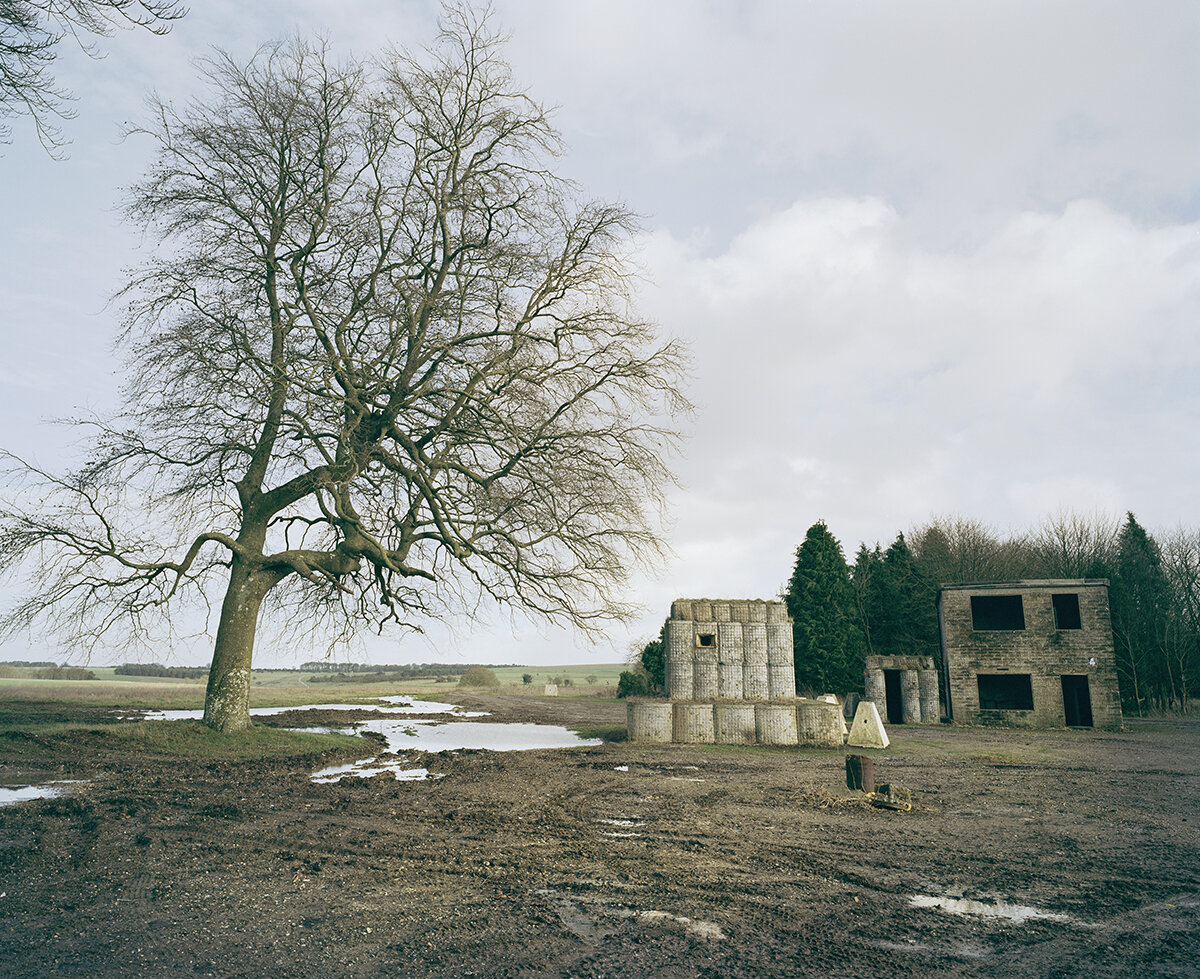
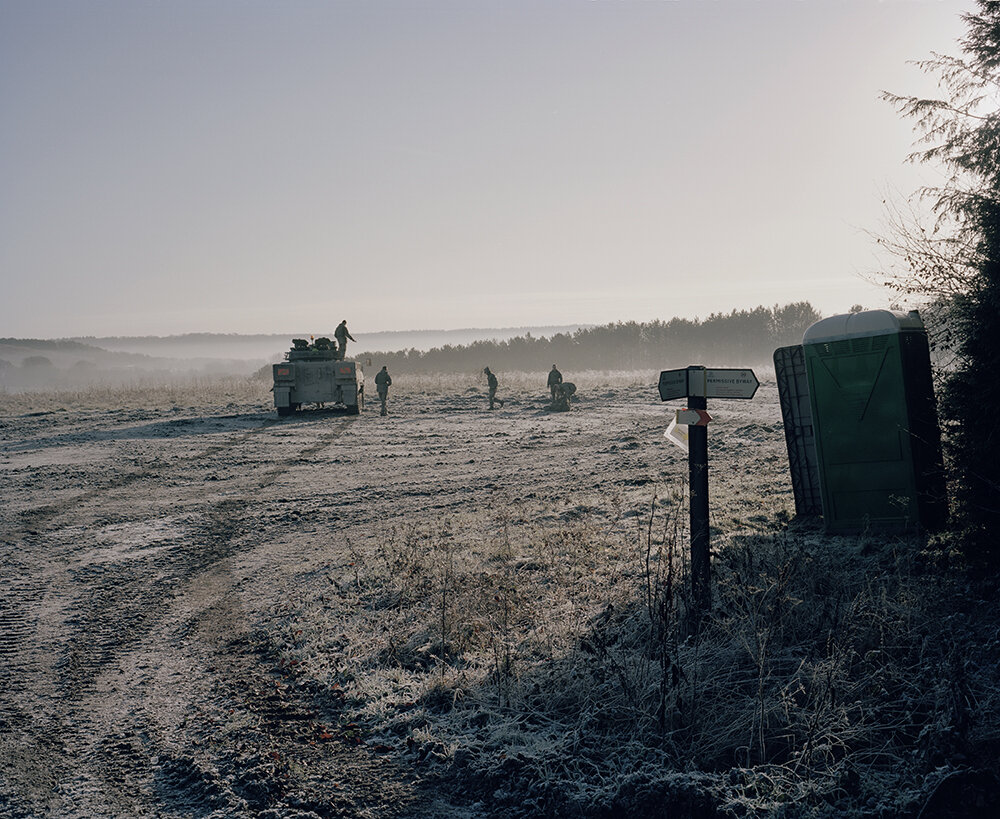
Fig. 3 takes a different approach. The image is taken in a way that somebody might take a snapshot on a snowy or frosty day with many of the subjects in silhouette. In the middle ground we see soldiers and a military vehicle set in front of a beautiful, countryside scene; again the contrast. In the foreground we see what looks like a portaloo cabin, perhaps for the soldiers, and a permissive right of way signpost that looks very similar to the standard footpath signs seen all over England. This for me adds a third tension. We have the soldiers and the countryside in the tension seen in all Friend’s images, but now the signs draw attention to a question of whose land is it anyway? Would I want to be walking in the countryside along footpath to be confronted by military manoeuvres? It draws into question the relationship between the two, the land may be protected, but has it been rendered into something that whilst technically is accessible for the public, in reality is not?
Reflection
This body of work appealed to me greatly as it investigates a topic that I have become increasingly more interested in as I have studied this course, that been the different relationships that exist between man and the land. In this case it is between the military (or state) and the land. In my assignment 1 I was reflecting on the slightly arbitrary nature of drawing boundaries to signify AONBs, in Assignment 2 on mans attempts to mark out ownership of land with wires, and in Assignment 3 the impact of ‘sustainable’ wind power to a landscape.
Some key learnings from my review are:
- It is the interplay that Friend has made the point of each image. One might not realise this if only looking at one image, it is only by studying them to find that interplay that it becomes apparent. This has two effects, firstly it draws one in to each picture and secondly, it makes one reflect on that interplay more than if it were shown in the same way in each image.
- Following on from point 1, this variety of ways of showing the interplay is what I see as the creative part. It would have been easy to take a series of images much like Fig. 2 but this would have been far less impactful. The clarity of what the point of the images is, combined with the creative way in which that point is shown in each image, I find very powerful. It is important to note that this only works as a set, one image by itself does not necessarily get the point across.
- The cohesive nature of every image adds to its own individual weight, Fig. 1 being aesthetically pleasing and so taken on a sunny day, Fig. 2 showing the empty building so taken on a grey day and on a winter’s day so that the tree is also bare.
- It takes time to build a set such as this. Friend’s careful use of weather and seasons no doubt extends the period but even without, it requires a considerable time investment. In a way this gives me more confidence since this is clearly not the environment that one can work in for an assignment.
Bibliography
Friend, M., 2021. The Plain — Melanie Friend. [online] Melanie Friend. Available at: <https://melaniefriend.com/the-plain/> [Accessed 23 July 2021].
Figures
Figure 1. Friend, M., 2017. The impact area near the White Horse Trail. Splinter proof observation shelter on the horizon. October 2017. [image] Available at: <https://melaniefriend.com/the-plain/> [Accessed 23 July 2021].
Figure 2. Friend, M., 2016. Beach’s Barn, a FIBUA (Fighting in Built-Up Areas) location used for military training. February 2016. [image] Available at: <https://melaniefriend.com/the-plain/> [Accessed 23 July 2021].
Figure 3. Friend, M., 2021. Warrior tracked armoured vehicle at the tank obstacle course. January 2020. [image] Available at: <https://melaniefriend.com/the-plain/> [Accessed 23 July 2021].