Delahaye began his photographic career as a documentary prhotographer and in that role, won three World Press Photo awards and the Robert Capa Gold Medal for reportage twice (O’Hagan, 2011).
Looking at the images he took during this area, they are shocking in their directness of capturing the consequences of war. Fig. 1 is an example.
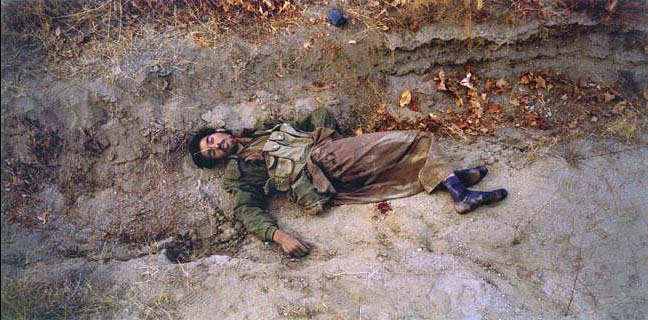
Whilst we might have become used to seeing dead people in war images, one does not normally see them like this. Perfectly framed as if this were a portrait, except this person is dead. I find it disturbing. Delahaye himself says “This is an example of fast…In my head I am thinking only of the process.” He goes on to say “This is what allows me to maintain an absence or distance to the event. If I impose myself too much, look for a certain effect, I’d miss the photo. This happened very fast; I need to make it slow. I see the two crossing in my mind.” (Delahaye 2003 cited in Sullivan, 2003).
This gives a hint as to why Delahaye went on to change his photography to a more distant style. He switched to using large format cameras and stepping back from the immediacy of the action (O’Hagan, 2011). Delahaye says “In war, there is a visual disorder, something extraordinary that works on appearances. Often in a devastated city, one has the impression that the forms are released. A building is not locked up any more in its function, it is not any more this beautiful object designed by an architect. It starts living again in a kind of insane way, before final collapse.” (Delahaye 2003 cited in Sullivan, 2003). This perspective I find interesting. His image in Fig. 2 perhaps shows how this way of thinking is apparent in his images.
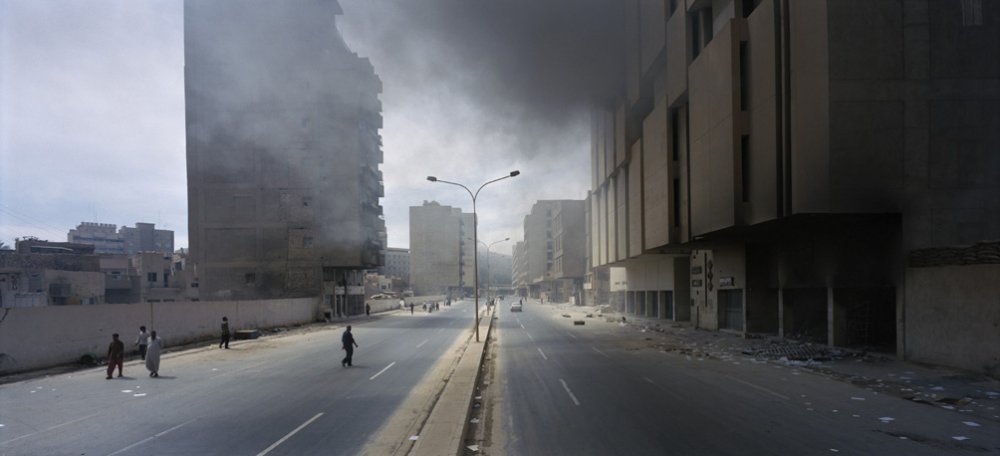
We see people, and we smoke that is presumably the result of a bombardment or a subsequent fire. But also we see the buildings, some now in ruins, lining the street. I get a sense of order, a sense of how it was, but also now the sense of disorder of the place and find that it relates to his comments above. This has become a picture that is about war, but is also about capturing the sense of the place at the time.
In Fig. 3 we see an even more detached composition.
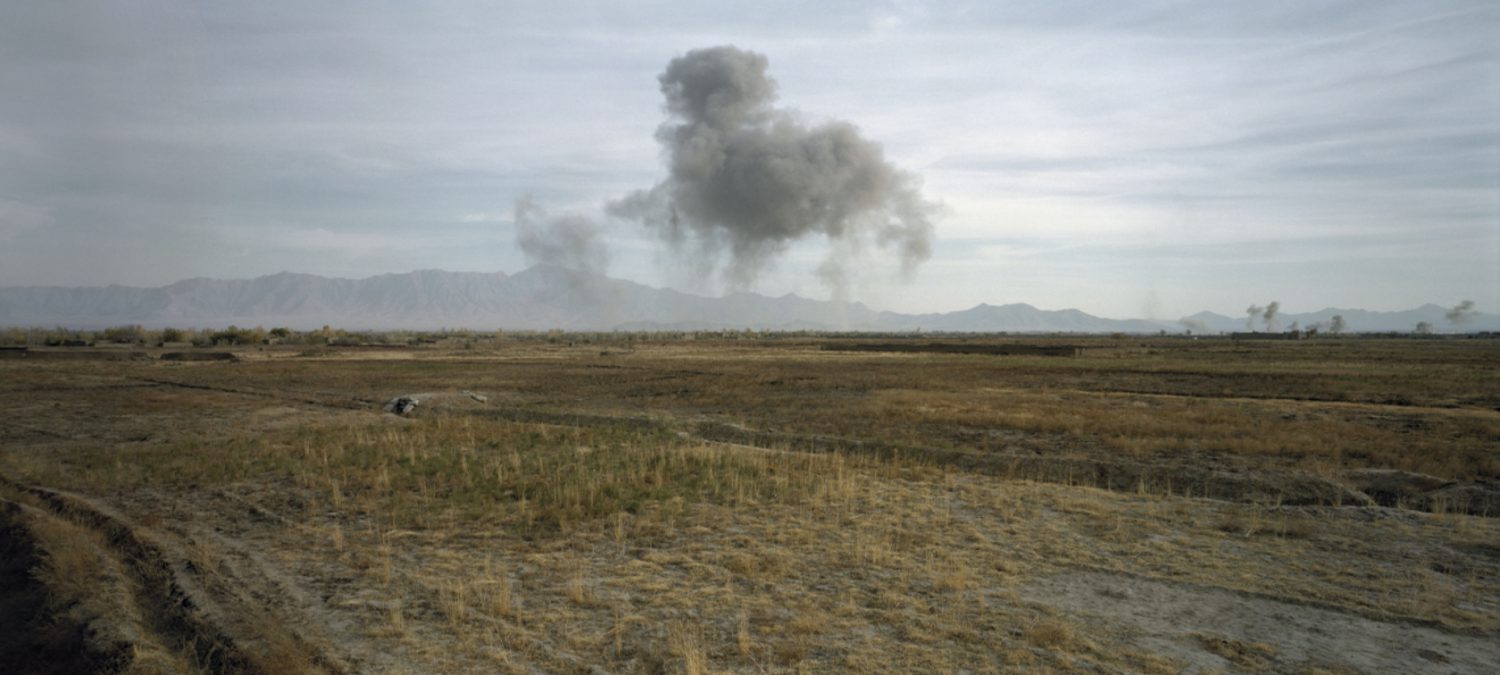
We see a desolate scene looking out across the Afghan landscape and a plume of smoke in the distance. The title of the image tells us that this is the scene of a bombing by US forces against the Taliban. When I look at the image I see first and foremost the desolation of the landscape, the emptiness. It is only the smoke plume that tells us that this is a war image at all. Without that, the landscape would look exactly the same, I think. Does the image work as a war image? When I look at the image it does make me think of the war, because of the smoke, and think about how remote everything was. It seems to create a space, a vastness, that one is not used to seeing in a war image. That vastness triggers in my mind a sense of the enormity of the challenge for either side in winning the Afghan war. It gives me a very different perspective, even the wide format of the crop emphasises that further. In that sense, the image does work.
Learnings
Three very different images are shown. Fig.1 is as all about the intensity, the in-your-face harshness of war. Fig. 2 and 3 step back.
In Fig. 2 I can see the way in which the image is about the place, and the buildings but how Delahaye has included elements from the war (the smoke and the people) to emphasise the living nature of the scene – if I had been taking that image, I think I might have tried to remove those elements from the scene in order to ‘control’ the viewer, to make sure that they looked at the buildings. The image would have been less powerful if I had done that.
In Fig. 3 it is the vastness of the scene that really strikes home. I think I might have tried to focus in on the detail, being worried that it was the detail that people wanted to see the most. Maybe such a shot would, in its own way, have been impactful, but, it would have told a different story to the one told here. I think the point is to step back (not literally) and think about what is the message one is trying to convey and how best to achieve that. Then being brave enough to allow the viewer to draw their own conclusions – letting go of controlling the viewer is something I have been learning to deal with all of the way through my degree studies.
Bibliography
O’Hagan, S., 2011. Luc Delahaye turns war photography into an uncomfortable art. [online] the Guardian. Available at: <https://www.theguardian.com/artanddesign/2011/aug/09/luc-delahaye-war-photography-art?CMP=Share_iOSApp_Other> [Accessed 21 April 2021].
Sullivan, B., 2003. artnet.com Magazine Features — The Real Thing. [online] Artnet.com. Available at: <http://www.artnet.com/magazine/features/sullivan/sullivan4-10-03.asp> [Accessed 21 April 2021].
Figures
Figure 1. Delahaye, L., 1994. Taliban Soldier. [image] Available at: <http://www.artnet.com/magazine/features/sullivan/sullivan4-10-8.asp> [Accessed 21 April 2021].
Figure 2. Delahaye, L., 2003. Baghdad #4. [image] Available at: <https://www.scienceandmediamuseum.org.uk/what-was-on/luc-delahaye-photographs> [Accessed 21 April 2021].
Figure 3. Delahaye, L., 2001. US Bombing on Taliban Positions. [image] Available at: <https://www.huckmag.com/art-and-culture/photography-2/conflict-time-photography/> [Accessed 21 April 2021].