From the course material I investigated Ingrid Pollard further. In the course her work Miss Pollard’s Party and Pastoral Interlude are highlighted. In these series she reflects on her relationship, as a black person, with the British countryside which she sees as a an area occupied by predominantly white people, see Fig. 1. This caught my attention as it is something that I myself have experienced moving from London to the Cotswolds and with a wife who, although born in England, has an Indian background and therefore skin colour.
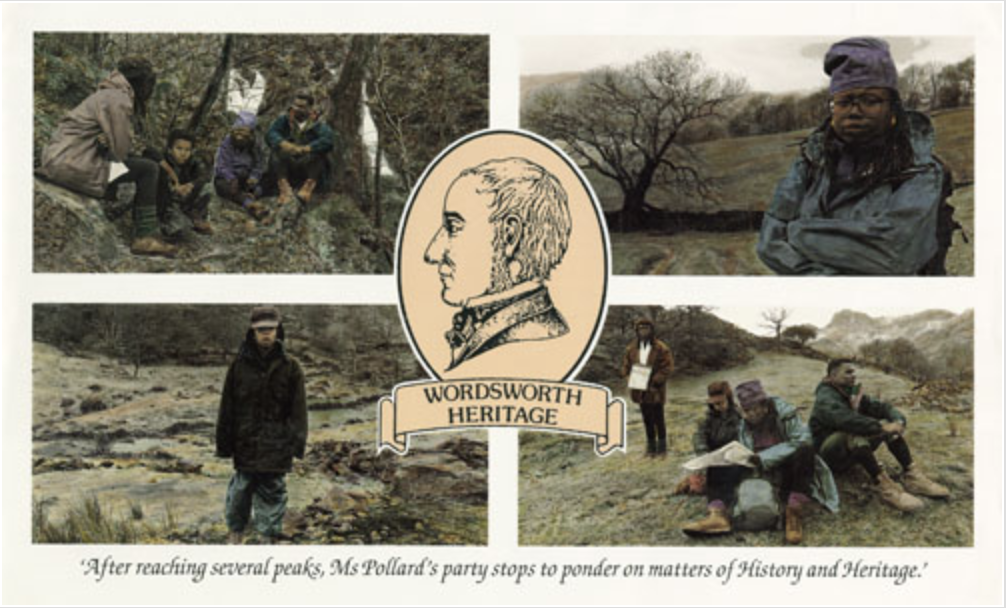
Fig. 1 is taken from Pollard’s series Wordsworth Heritage and is devised to look like a classic picturesque postcard of the countryside and was displayed on 25 billboards across the UK (Pollard, 1992). Two things strike me about this image. Firstly, the images within the ‘postcard’ framed as typical tourist snaps but with Pollard self-positioned as a dominant character in each of the scenes. We are used to seeing many images like this on postcards, on in more modern times on Instagram and it does look different having a black person in the scene. This to me emphasises how ones eyes, and thoughts, can be conditioned by seeing many images of one composure to the extent that we do not stop to reflect on what we are seeing. Pollard manages to change this with her approach. The second feature is Pollard’s use of text in the caption of the ‘postcard’. She has taken a quote from Wordsworth, the namesake of the series itself. It is a very choice quote as it does indeed make the viewer, or reader, stop and ponder on these images. It reinforces the effect that Pollard is looking to achieve with the images themselves, and for me, the fact this particular interpretation of pondering on history and heritage was almost certainly not the one that Wordsworth intended makes the image and the text far more poignant.
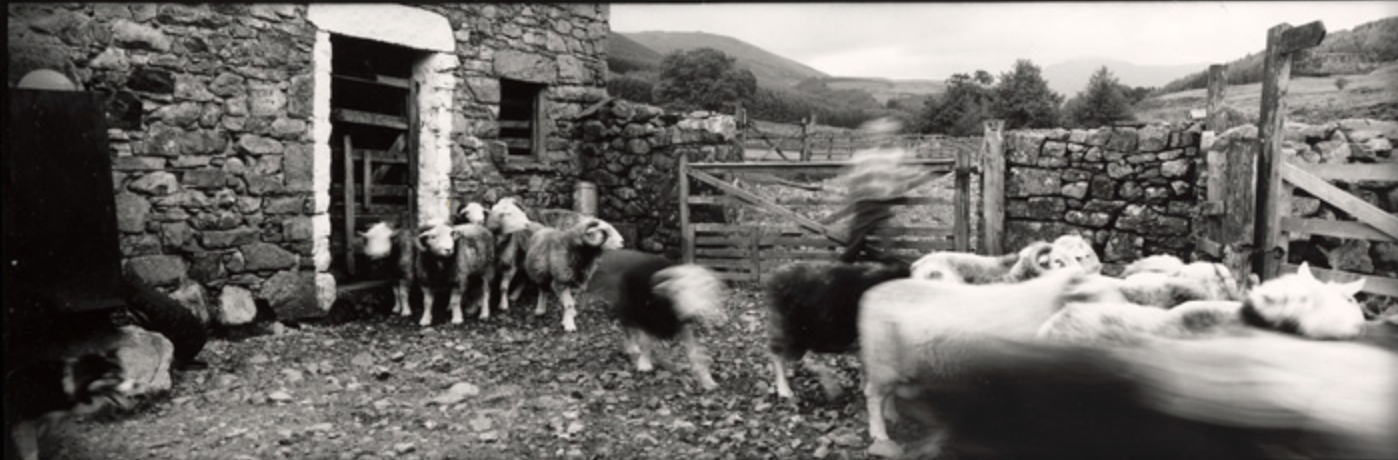
Listening to Pollard discussing landscape in a Tate gallery interview (Tate, 2009), I heard her discussing her series ‘Bursting Stone’ in which she discussed her view of the landscape and how the landscape is often defined by its boundaries, either within the landscape itself or at the boundary of the towns and countryside. She highlighted that much of what we see as traditional English countryside is in fact a product of industry, again this is a topic that I have become very interested in as is show in my choice of subjects for my assignments. Fig. 2 shows an example she mentioned. In the image we see classical picturesque landscape in the background, but as with her approach in Wordsworth’s Heritage, she has placed her contradiction right in front of the backdrop. In this case we see the sheep and farmers moving, as if they are transitory in this landscape, and we see the walls of the farm blocking the view of the landscape itself, creating a separation between the beauty of the landscape and the viewer. The image is cropped in a panoramic format, again this would typically be used in a landscape scene rather than a scene of a sheep farmer and further serves to highlight that if the farm were not there, the viewer would be looking at a panoramic, picturesque, landscape.
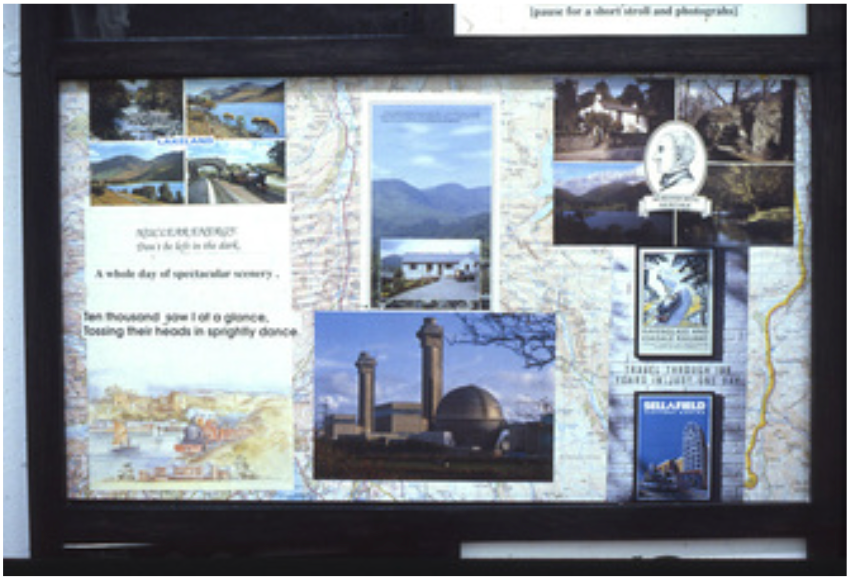
In her series, The Cost of the English Landscape, Pollard looks at the contrast between idealised tourism narrative, and the reality of industry in the Lake District. In Fig. 3, we see an image the Pollard created by using one of typical maps that one might find on popular tourist walking routes and that usually highlight local points of interest or viewpoints. Here though Pollard has mixed together some of the classical postcards one might find (one of them possibly being the inspiration for her earlier Wordsworth Heritage postcard idea) but also images of the Sellafield nuclear power station that is located in the area. Again Polard has managed to combine different perspectives in a thought provoking way, we have the contrast of the postcards and the images of the power station, but also the fact that they are all presented in a traditional tourist information point which reinforces how these are all brought together in the same landscape.
Learnings
Pollard has investigated many issues that I myself have found to be of interest, those being:
- Our perception of the landscape and what it should look like
- The way in which industry impacts the landscape
- Boundaries in landscape and their impact
- Ethnicity in the English countryside
All of these interests meant that I was very focussed on understanding the way in which she shows these issues in her images. What I saw in many images, and certainly in the three I have chosen, is that they she has taken to the time to show the traditional view as the backdrop to the image, but then in a very non-subtle way placed her opposing right into the front of the image. There is no subtle juxtaposition of the two perspectives, instead, one is overlaid directly over the other.
Pollard’s approach is very different to mine thus far. I have tended to adopt a more subtle approach, a gentle juxtaposition and rely on the viewer to spot a trend across a series of my images. Pollard’s approach means that inferences can be taken from just a single image.
On realising this point, I can feel myself drawn to the approach and am keen to explore it further in my own photography.
Bibliography
Pollard, I., 1992. Wordsworth’s Heritage. [online] ingrid pollard photography. Available at: <http://www.ingridpollard.com/wordsworths-heritage.html> [Accessed 14 July 2021].
Tate, 2009. Ingrid Pollard on Landscape. [podcast] Conversation Pieces. Available at: <https://www.tate.org.uk/context-comment/audio/conversation-pieces-audio-recordings#open242841> [Accessed 14 July 2021].
Figures
Figure 1. Pollard, I., 1992. Wordsworth Heritage. [image] Available at: <http://www.ingridpollard.com/wordsworths-heritage.html> [Accessed 14 July 2021].
Figure 2. Pollard, I., 1997. Bursting Stone. [image] Available at: <http://www.ingridpollard.com/bursting-stone—selected-images.html> [Accessed 14 August 2021].
Figure 3. Pollard, I., 1989. The Cost of the English Landscape. [image] Available at: <http://www.ingridpollard.com/the-cost-of-the-english-landscape.html> [Accessed 14 August 2021].