Stroud’s industrial heritage is rich, the town is famous for the production of cloth helped by its five valleys and rivers that were used to drive the mills. One of the main areas that the industry focussed on was Chalford (Industrial Heritage | Visit the Cotswolds Stroud District, n.d.). In fact, “From the 1500s until the late 20th century, Stroud and the surrounding valleys were home to over 100 mills.” (Edwards, 2018).
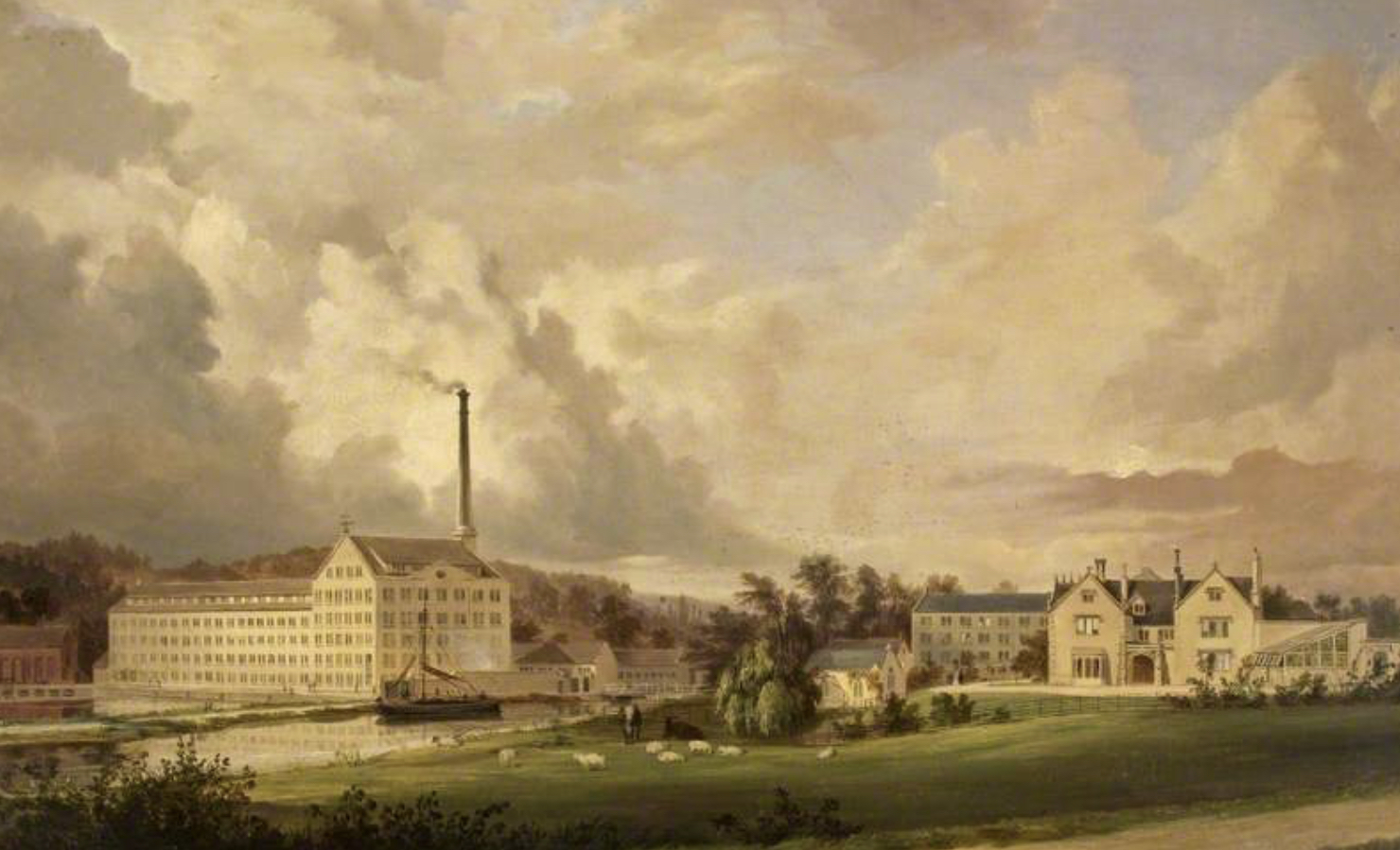
Fig. 1 below for me sums up the glamour of the era. In the image we see the mill at Evelyn alongside the mill owner’s Manor House (Ebley Cloth Mills, Stroud, Gloucestershire | Art UK, n.d.) . But the mill itself is shown gleaming in the light and towering over the countryside, like a symbol of greatness, the very tall smoking chimney dominating everything around. The inclusion of sheep in the foreground may well be added by the artist but what they achieve is some pretence that the gigantic mill is still a part of the traditional countryside (the south Cotswolds also being famous for the breeding of sheep.
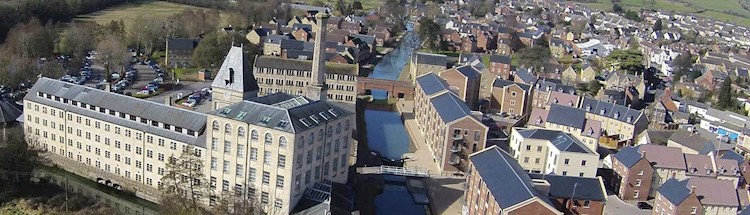
This particular mill these days is home to Stroud District Council, the heritage of the mill continuing although now shown in a different light by the council itself, see Fig. 2. Other details in the area seem to have survived, the lock clearly visible in Fig. 2 just visible in Fig. 1. The owner’s Manor House no longer seems to be there although curiously, the new building now built in its place seems to have been built with a nod towards what was there before.
I have focussed on mills and the associated textile industry because it has had such an impact on the local area. “Every part of Stroud’s district bears an imprint of the international industry, which evolved here between the Middle Ages and the 19th century. Weavers’ cottages were carved into Chalford’s hillside, and the gracious Cotswold stone villages of Painswick, Bisley and Minchinhampton were built with wool merchants’ profits. But the most impressive legacy is the ‘string of pearls’ – the collective name for the fine line of mills – which once roared with the deafening sound of fulling stocks and water wheels” (The Mills | Visit the Cotswolds Stroud District, n.d.).
This passage, produced as part of the local tourist site sums up the area and how, over hundreds of years, an industrial landscape is now thought of as the ‘Chocolate Box’ Cotswolds and is an AONB that supports postcards such as those I found in my research for Exercise 3.2. I myself live in a 300 year old listed cottage that was once that of a Shepard and so the subject feels very close to home.
In “18th century Stroud and the surrounding district were famed for the quality of the cloth produced and for the rich hues of the dyes, some of them invented by local men” (Baggs, Jurica and Sheils, 1976). These words portray success and achievement and align strongly with the emotions evoked in Fig. 1.
Today, the mills are in some cases protected yet rotting away, and in other cases repurposed, as with Ebley Mill now being home to Stroud District Council, Fig. 2. In my first assignment of this course, I captured scenes from the Stroudwater canal that runs alongside the river that fed the mills, of course it was used to transport the raw materials to the mills and the end product, the cloth, to merchants. It is the mills themselves that now capture my attention, in particular those that are rotting away as with them, so is our history.
In some cases, new buildings are erected in their their place, but the old names (shamelessly?) retained to evoke the golden era of the past, see Fig. 3. In the sales material accompanying the development shown in the figure, it is clear that the only thing remaining at the site is the old mill pond used as part of the mill that is now lost.
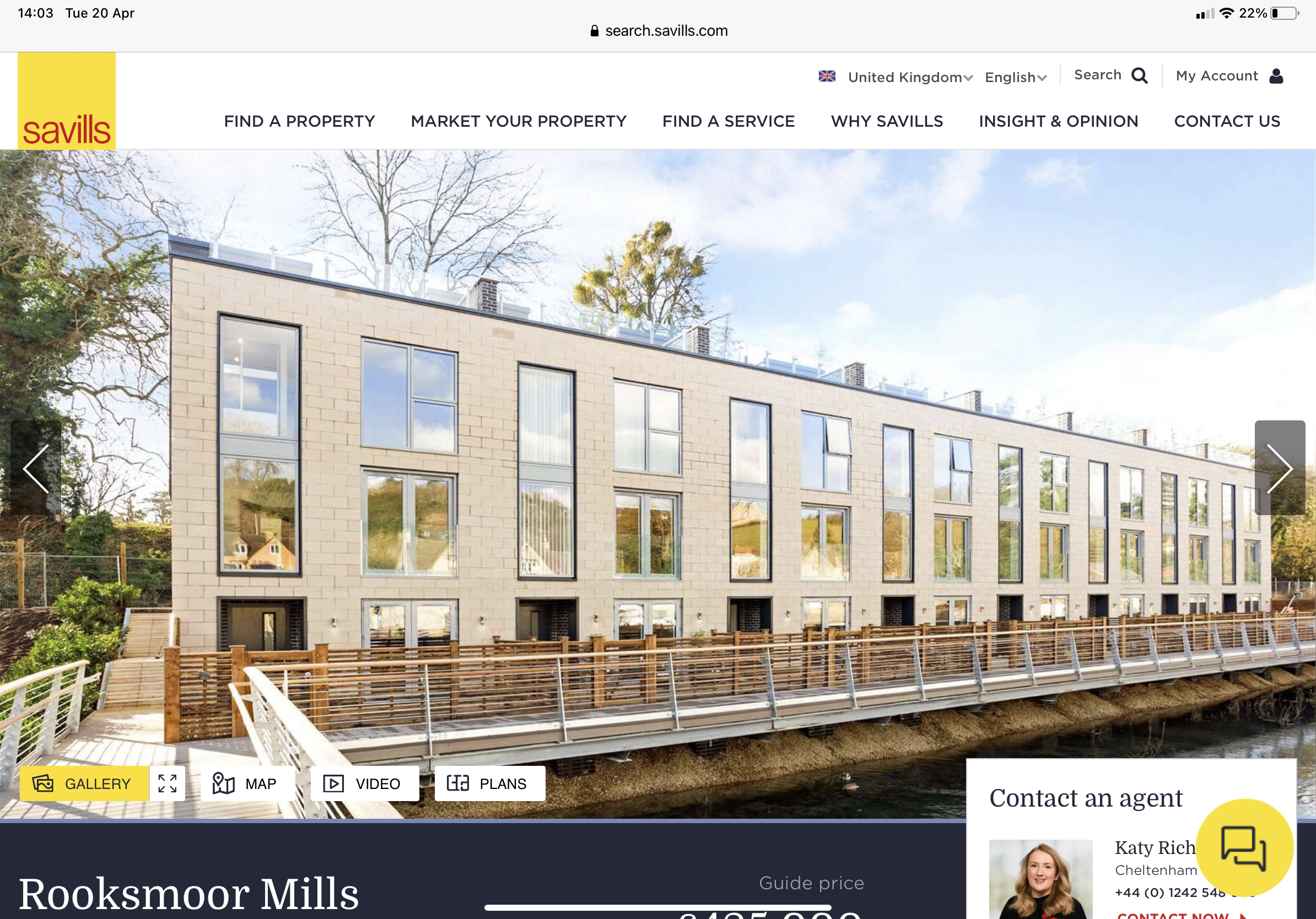
Fig.4 shows an 1830 view of how many mills there were spread across the region and gives a sense of how they dominated the area.
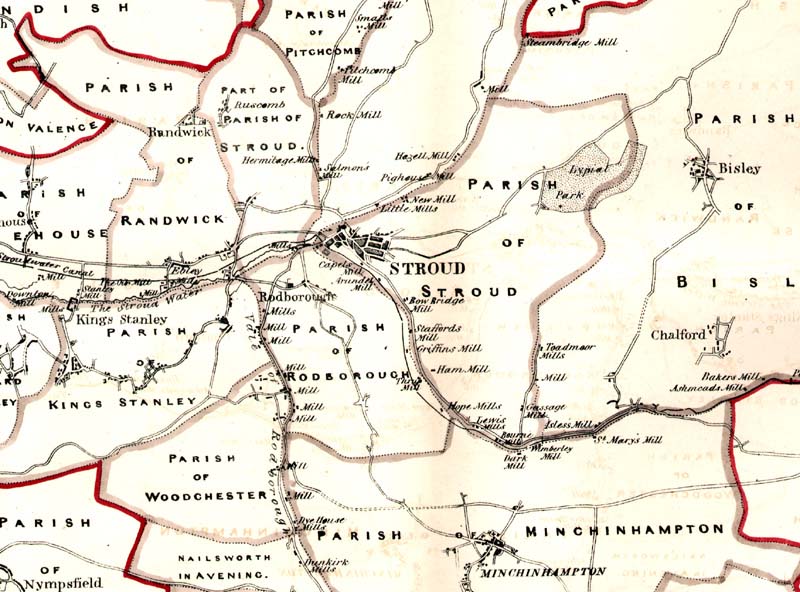
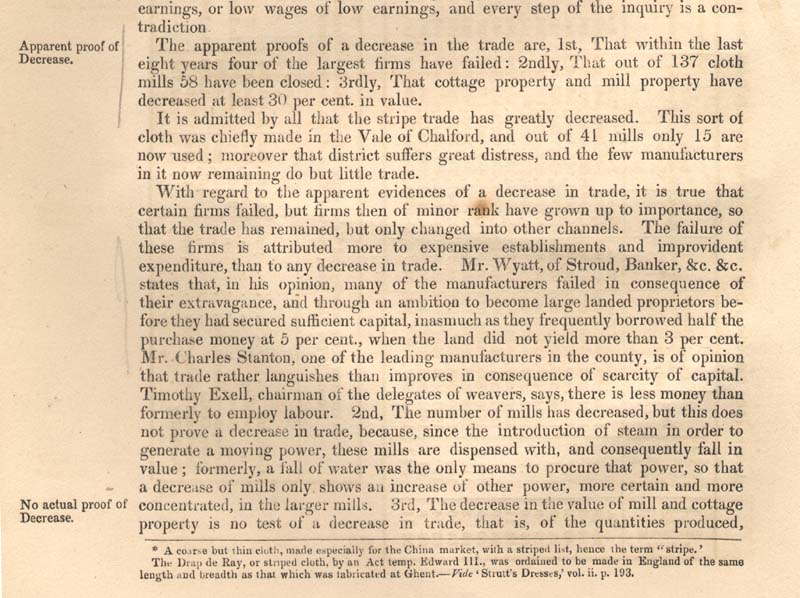
Sadly though, by the 1900’s, only a few were left and this is a decline that began mid 1800s as trade began to decrease with the 1840 GRO Miles report stating that 58 out of 137 mills had already closed, see Fig. 5.
The echos of this bygone era are still there to be seem, but I wonder how long before they all become modern developments with only the names to remind us of the past.
Bibliography
Visitthecotswolds.org.uk. n.d. Industrial Heritage | Visit the Cotswolds Stroud District. [online] Available at: <http://www.visitthecotswolds.org.uk/things-to-see-and-do/history-of-the-area/history/industrial-heritage/> [Accessed 20 April 2021].
Edwards, E., 2018. Cathedral Of Cloth. [online] Selvedge Magazine. Available at: <https://www.selvedge.org/blogs/selvedge/cathedral-of-cloth> [Accessed 20 April 2021].
Artuk.org. n.d. Ebley Cloth Mills, Stroud, Gloucestershire | Art UK. [online] Available at: <https://artuk.org/discover/artworks/ebley-cloth-mills-stroud-gloucestershire-62510> [Accessed 20 April 2021].
Visitthecotswolds.org.uk. n.d. The Mills | Visit the Cotswolds Stroud District. [online] Available at: <http://www.visitthecotswolds.org.uk/things-to-see-and-do/history-of-the-area/history/pedersen-cycle/the-mills/>[Accessed 20 April 2021].
A P Baggs, A R J Jurica and W J Sheils, ‘Stroud: Economic history’, in A History of the County of Gloucester: Volume 11, Bisley and Longtree Hundreds, ed. N M Herbert and R B Pugh (London, 1976), pp. 119-132. British History Onlinehttp://www.british-history.ac.uk/vch/glos/vol11/pp119-132 [accessed 20 April 2021].
Figures
Figure 1. Newland Smith, A., 1850. Ebley Cloth Mills, Stroud, Gloucestershire. [image] Available at: <https://artuk.org/discover/artworks/ebley-cloth-mills-stroud-gloucestershire-62510> [Accessed 20 April 2021].
Figure 2. Stroud District Council, n.d. Stroud District Council at Ebley Mill. [image] Available at: <https://www.stroud.gov.uk/council-and-democracy/about-the-council> [Accessed 20 April 2021].
Figure 3. Search.savills.com. 2021. Savills | Rooksmoor Mills, Stroud, Gloucestershire, GL5 5ND | New homes for sale. [online] Available at: <https://search.savills.com/property-detail/gbhmrdcnr200097> [Accessed 20 April 2021].
Figure 4. 1830. Dawson’s Map of Stroud. [image] Available at: <https://www.digitalstroud.co.uk/working-cloth>[Accessed 20 April 2021].
Figure 5. 1840. GRO Miles Report 1840. [image] Available at: <https://www.digitalstroud.co.uk/working-cloth-decline>[Accessed 20 April 2021].