Exercise Background
Reading the course text and Morley’s essay on sublime (Morley, 2010), taught me a new meaning to the word which I had previously understood to mean ‘nice’ in the incorrect manner as de Bolla describes in the BBC In our Time podcast (BBC, 2004), ‘that soup was sublime’.
In fact the meaning, or at least the meaning in the artistic sense, is an art piece that induces awe, maybe to an extent that there is no room for any other emotion, and specifically it is not anything to do with niceness or beauty. Morley discusses how, over time, this effect has become more difficult to achieve in paintings or (non-manipulated as least) photography because the awe that a landscape might once have produced has been numbed out of us by the sheer volume of work that now exists and that depicts almost every corner of our Earth and beyond.
Examples given by Morley as being most successful in recent times are sculptures or structures that create awe through their sheer size and scale, for example Eliasson’s The Weather Project (The Unilever Series: Olafur Eliasson: The Weather Project – Exhibition at Tate Modern | Tate, 2004).
Exercise
Choose any body of work that you feel explores the sublime.
Thoughts
Whilst it may be the case that as humans we have been numbed by the sheer volume of easily accessible images of our land, I did wonder about digitally manipulated images. If an image is manipulated to distort the truth to fill us with awe and is in done in such a way that is so subtle that it does not look manipulated, could this then be an example of a sublime image.
The body of work that came to my mind when considering this was that of Gursky. I saw his work at the Hayward Gallery in London where it was presented as huge prints perhaps 8 feet tall and 20 feet wide.
In a way, the sheer size of the print was awe inspiring by itself but what was particularly ‘sublime’ was the detail. We can see a billboard poster of this size but when viewed close up, one can easily see the pixels that make up that image. But viewing Gursky’s images close up reveals more detail even when viewed as close up as possible with ones eyes.
The effect of this detail leaves the viewer feeling is if they are looking at a real scene and, for some of the images which are actually manipulated, awestruck by the sheer scale and sheer amount of detail in scene.
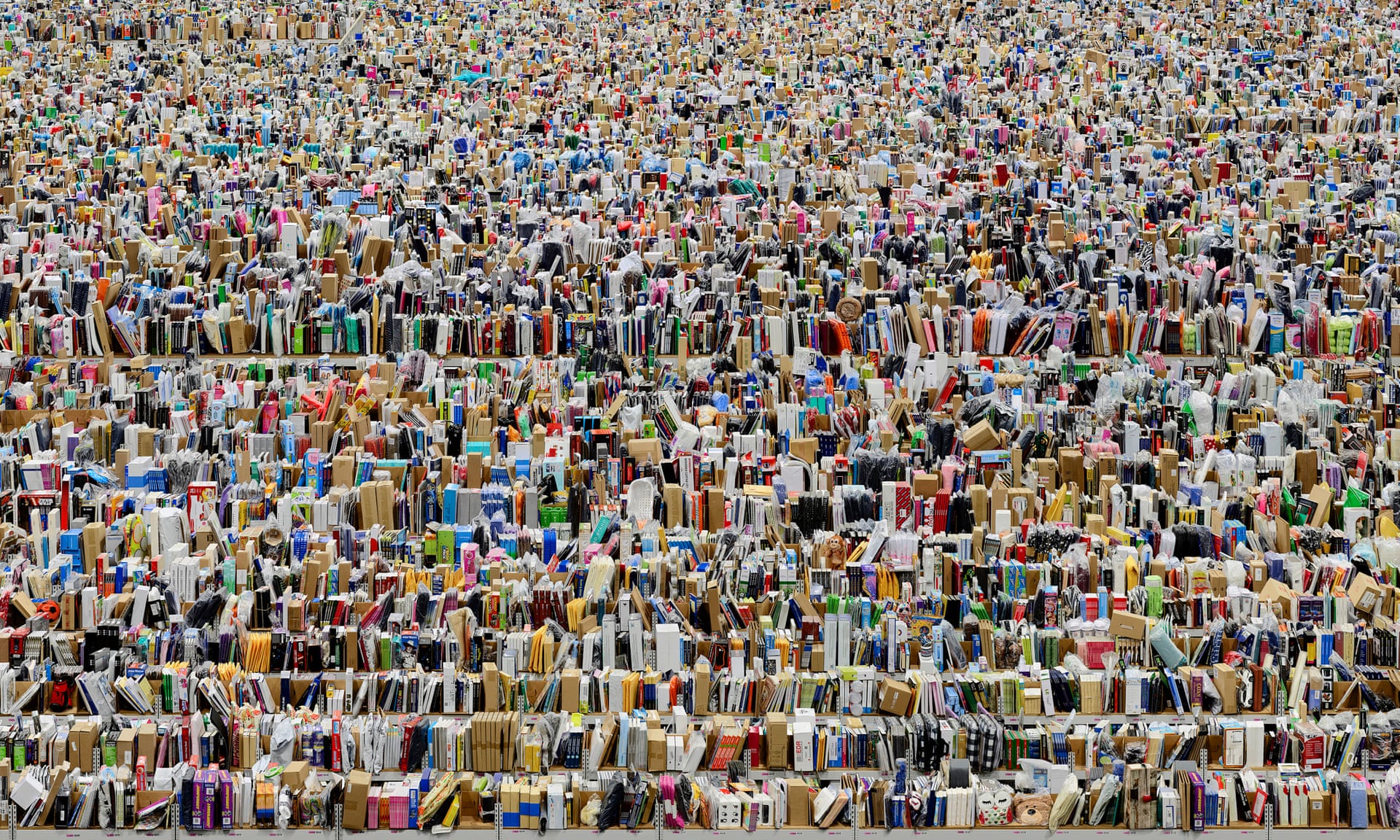
Fig. 1 below is a good illustration. The image is taken in an Amazon warehouse. Clearly the low resolution version attached here does not go anywhere close to the full scale 20 feet wide version. Looking at the image full size one is left in awe at the sheer number of items in the warehouse, what a challenge such a thing creates as a business venture, the complexity of running the warehouse itself, and the photographic skill to achieve such an image. There are so many reasons that I was in awe of this image that I believe it to be sublime.
This is a landscape course and therefore I also brought to mind one of the many landscape images that are part of Gursky’s collection. Fig. 2 below is the first one that came to mind. Again it is the scale of the image and the landscape that it depicts which causes the awe and again is why I think this image is sublime. Gursky states “It was 1990 and I was out driving with my family, sightseeing in and around Naples. Late in the afternoon, we came across this view over the harbour of Salerno. The sun was setting over the city so I had to hurry. I set up my tripod and my 4×5 inch camera, then took four frames. There was no time to weigh up whether it was worth it or not.” (Gursky 2018, cited in Sawa, 2018)

In the quote, we learn how Gursky achieves such detail. I see the detail in the port, then the port town extending up into the mountains, the stunning mountains behind, and then a sky that is bright but holding detail. I find it incredible and therefore sublime.
Learning
Despite what Morley says, Gursky’s images here prove that sublime is still possible to achieve with landscape images. But, I am sure that there are many images of Salerno but not many such as the one shown here.
The learning is that sublime is actually possible in more places than one might imagine and that it is in fact a deliberate outcome that can be achieved by the photographer rather than something that is necessarily created by the landscape itself.
Bibliography
Morley, S., 2010. Staring Into The Contemporary Abyss: The Contemporary Sublime – Tate Etc | Tate. [online] Tate. Available at: <http://www.tate.org.uk/context-comment/articles/staring-contemporary-abyss> [Accessed 3 November 2020].
BBC, 2004. The Sublime. [podcast] In Our Time. Available at: <https://www.bbc.co.uk/sounds/play/p004y23j> [Accessed 3 November 2020].
Tate. 2004. The Unilever Series: Olafur Eliasson: The Weather Project – Exhibition At Tate Modern | Tate. [online] Available at: <https://www.tate.org.uk/whats-on/tate-modern/exhibition/unilever-series/unilever-series-olafur-eliasson-weather-project> [Accessed 3 November 2020].
Sawa, D., 2018. Andreas Gursky On The Photograph That Changed Everything: ‘It Was Pure Intuition’. [online] the Guardian. Available at: <https://www.theguardian.com/artanddesign/2018/jan/18/andreas-gursky-each-photograph-is-a-world-of-its-own-best-photograph-salerno-harbour?CMP=Share_iOSApp_Other> [Accessed 3 November 2020].
Figures
Figure 1. Gursky, A., 2016. Amazon. [image] Available at: <https://www.theguardian.com/culture/2018/jan/26/andreas-gurskys-amazon-exposing-the-mindlessly-cruel-forces-of-global-capitalism> [Accessed 3 November 2020].
Figure 2. Gursky, A., 1990. Salerno 1, 1990. [image] Available at: <https://www.theguardian.com/artanddesign/2018/jan/18/andreas-gursky-each-photograph-is-a-world-of-its-own-best-photograph-salerno-harbour?CMP=Share_iOSApp_Other> [Accessed 3 November 2020].