Introduction
Baltz was born in California in 1945 and died in 2014, his images are therefore captured in the second half of the twentieth century. Baltz “viewed the landscape as an urbanized, structured and populated space, and portrayed these constructions as being muted and virtually faceless” (Lewis Baltz, Exposition, Photography, Fundacion MAPFRE, Madrid, Spain, 2017).
Baltz’s approach to photography is perhaps best known for his participation in the 1975 exhibition New Topographics: Photographs of a Man-Altered Landscape, which brought together multiple photographers to exhibit their images. This was a collection that was known for being “a reaction to the tyranny of idealised landscape photography that elevated the natural and the elemental” yet one in which “seemed to posit an aesthetic of the banal” (‘Hagan O, 2010).
This paper reviews Baltz’s Candlestick Point collection, which itself was not part of the New Topographics exhibition, although the images follow from its intent. The paper compares the collection with images from other photographers who participated in New Topographics to understand what it is about Baltz’s images that makes them distinct from others and to review them in the context of what that exhibition stood for.
Candlestick Point
Baltz released his collection Candlestick Point in 1989 (Candlestick Point – Lewis Baltz, n.d.) It contains a series of stark images of a landscape in California that was becoming industrialised, or built upon. The collection was very much in keeping with Baltz’s style which Heiferman describes as a “topography of the emptiness of random, damaged, remote places” (cited in Candlestick Point – Lewis Baltz, n.d.). Each image shows the land impacted by machinery and usually with piles of debris strewn across the landscape. Images within the book are collated into a series of monochrome images followed by a similar collection but in colour. Fig. 1. and Fig. 2 show typical images of each type.
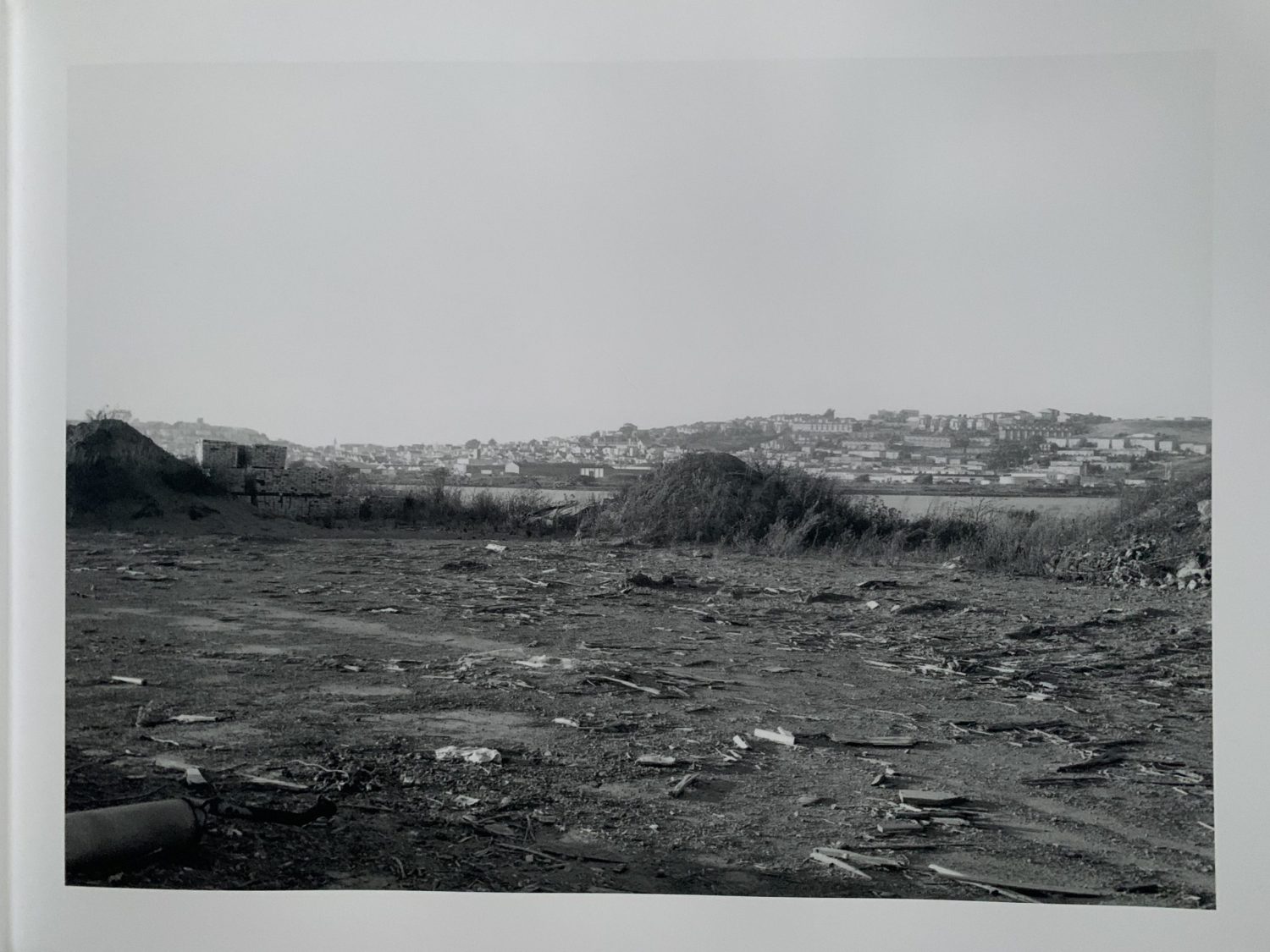
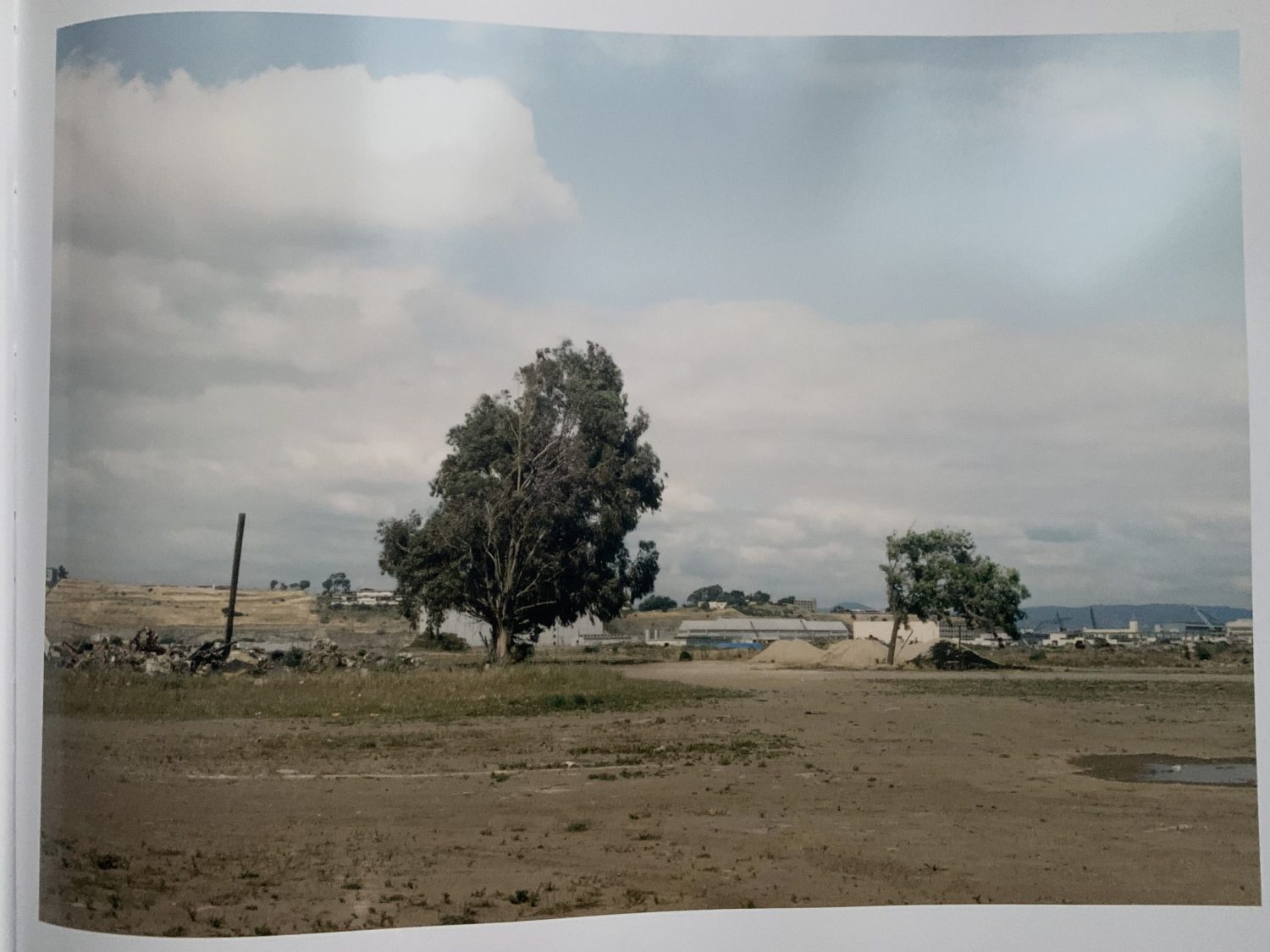
It is not clear what the significance of this colour choice is. There are significantly more monochrome images than colour but they are all similar in nature and framing; it is almost as if Baltz or the curator was unable to choose which was more effective and so both were included.
The majority of the images are framed as shown, loosely framed, expansive views across the landscape. In a discussion between Baltz and Heiferman this framing choice was discussed as Heiferman points out that in earlier collections such as ‘The Tract Houses’ the framing was tighter, see Fig. 3 for an example. Baltz replies “I wanted to include more sweep, I wanted objects to be less important in the frame …I wanted to use the German term Abstand – which is just distance in both senses of the word” (Heiferman, 2010).
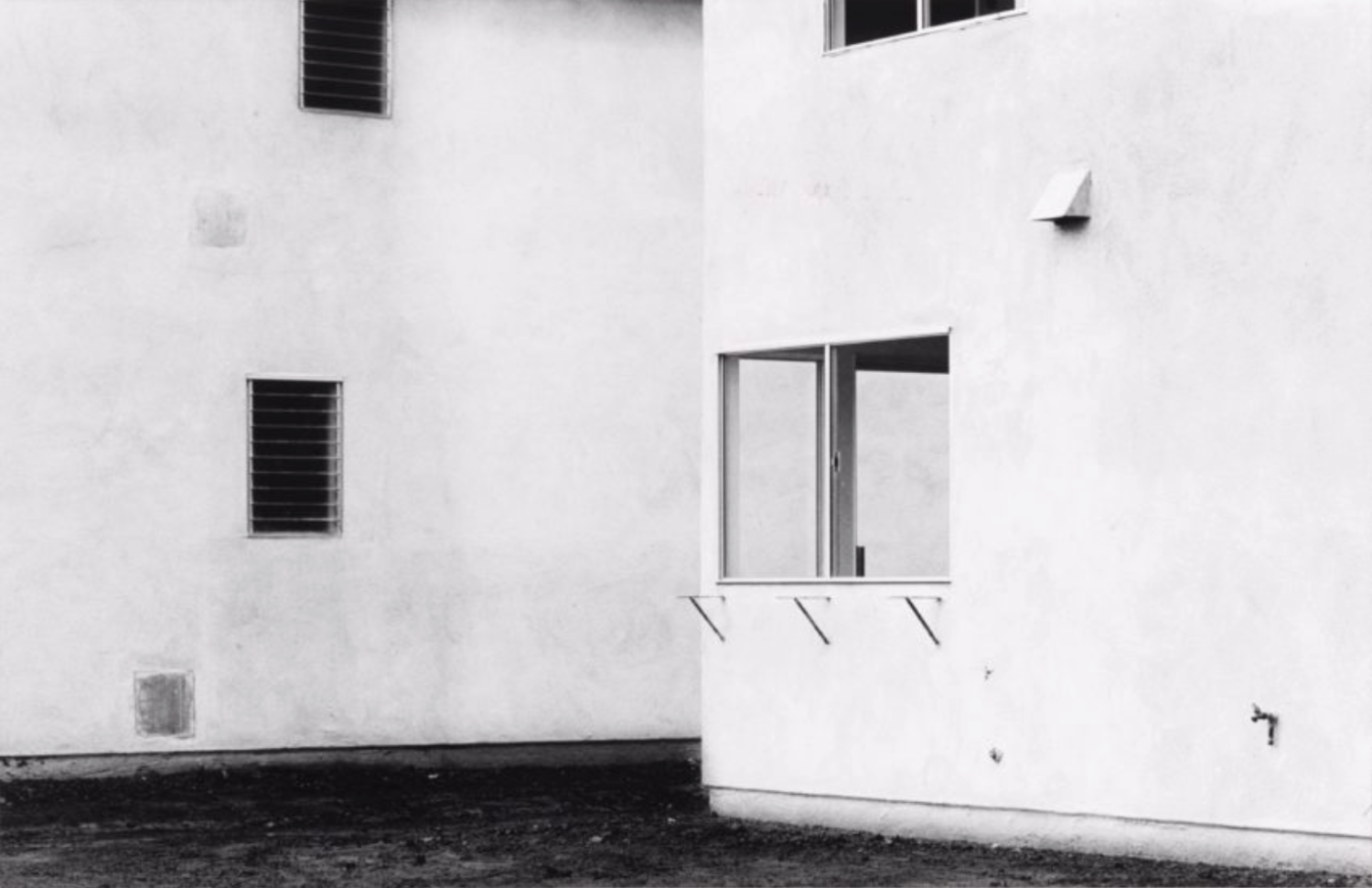
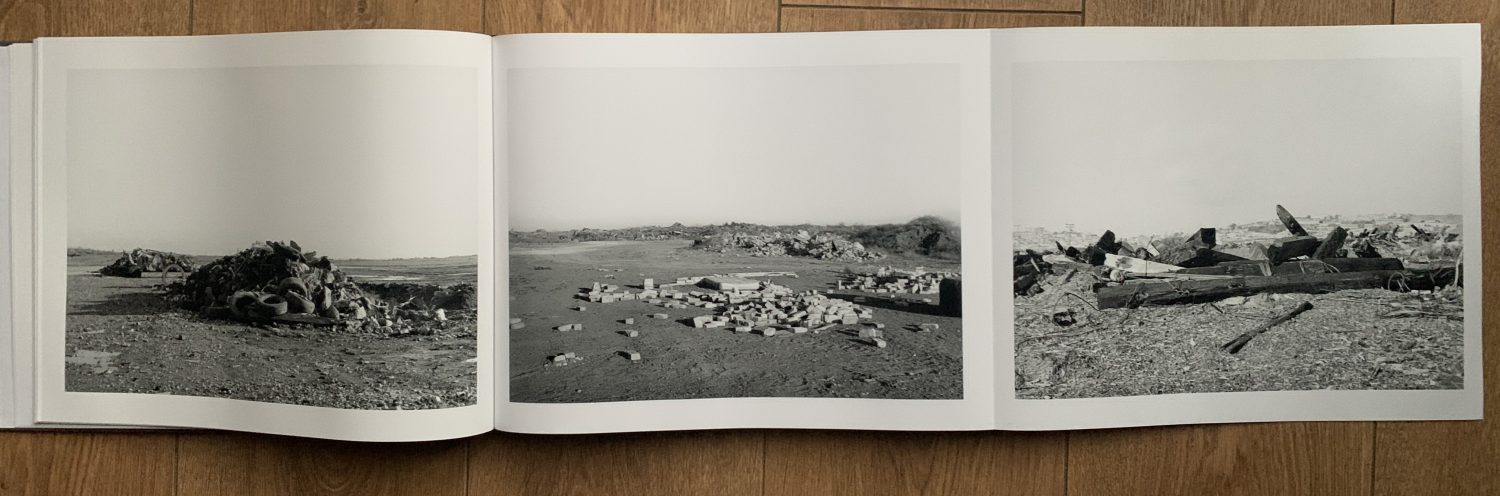
Applying that intent to Candlestick Point, it is clear that it is the vastness of the space, the sheer extent of man’s impact to the land that is felt most. Pages in the book are un-numbered and usually single but there is an occasional blank page or fold out; ostensibly this is to break the rhythm of the page turner but when these pages are seen spread out, meaning that three images are viewed at once, this vastness is emphasised, see Fig. 4 for an example.
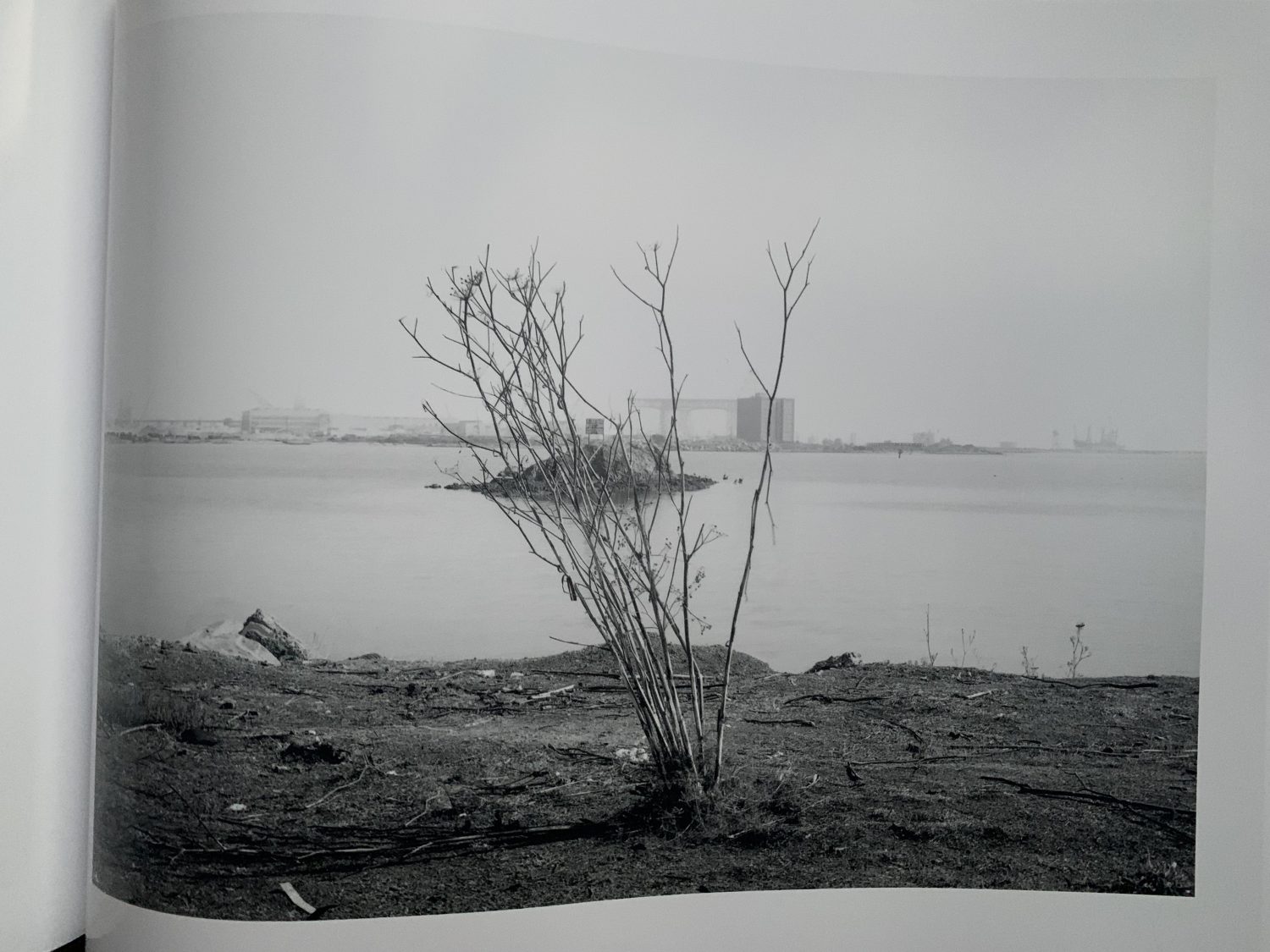
There are contradictions to this approach of capturing the wide expanses, see Fig. 5, where Baltz has chosen to place a distinct feature front and centre in the frame. In the example shown, the composition is not what one might have expected as Baltz has captured the elements of the image obscuring themselves when a few paces to the right would have meant that the elements, a foreground bush, a mid-stream island and a building in the background, were positioned in a straight line and would have led the eye through the frame. As shot, the viewer is forced to see the scene whilst looking through the bush and this forces the viewer to focus on each item in turn, instead of sweeping their eye through the frame. This approach does mean that the viewer spends longer on each element, which is perhaps Baltz’s wish. Maybe there is also a metaphor here, the bush growing in the foreground, on the near shore stands almost in rebellion to the commercial buildings in the background, which in this interpretation appears fenced off by the naturally occurring water.
It is noticeable in all of the images that there are no people. When asked about this in an interview, Baltz replied “I’ve thought that when people appear in a picture, they are automatically perceived as the subject … I wanted the only person in the picture to be the viewer” (Heiferman, 2010). A contrast to this approach can be seen in Fig. 6 with an image from Clanet who created a series of images photographing hydro-electric structures.
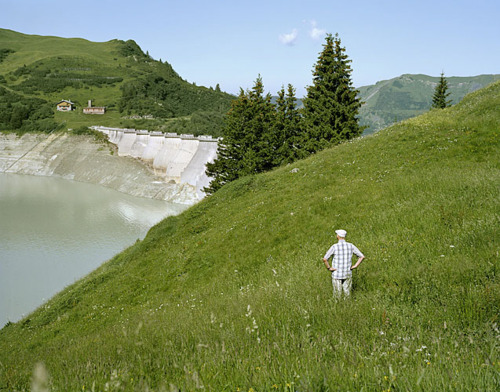
Clanet “photographed several people who had a working relationship with the structures” (Alexander, 2015:122). The contrast between the two approaches is stark. If one ignores the differences in framing approach, ie Clanet’s use of a classic landscape tradition compared to Baltz’s straight photography, the presence of a person in the frame changes the image entirely. The person, positioned exactly on the bottom one third of the frame, looking over the scene, draws the eye of the viewer at least as much as the dam which would otherwise capture nearly all of the attention, it also seems to be the final resting place for a typical viewer. Baltz’s absence of any people leaves the viewer studying all of the landscape elements far more thoroughly.
New Topographics
The images from Candlestick Point are not part of the original New Topographics exhibition but they are similar to Baltz’s images what were. The exhibition “confronted the discourse of landscape representation … including its sprawling suburbs, parking lots, and other burgeoning industrial and domestic infrastructure” (Alexander, 2015:126). With a description like that, it is clear how Candlestick Point relates. The exhibition was intended to be “the opposite of the Romantic sublime Western landscape of the nineteenth century, or its twentieth-century photographic counterpart that can be seen in the work of Ansel Adams and Group f/64” (Artspace, 2016).
Other photographers took different approaches. Bernd and Hiller Becher adopted a typography approach, rigorously capturing sites such as coal bunkers and arranging the images in a grid framework, see Fig. 7.
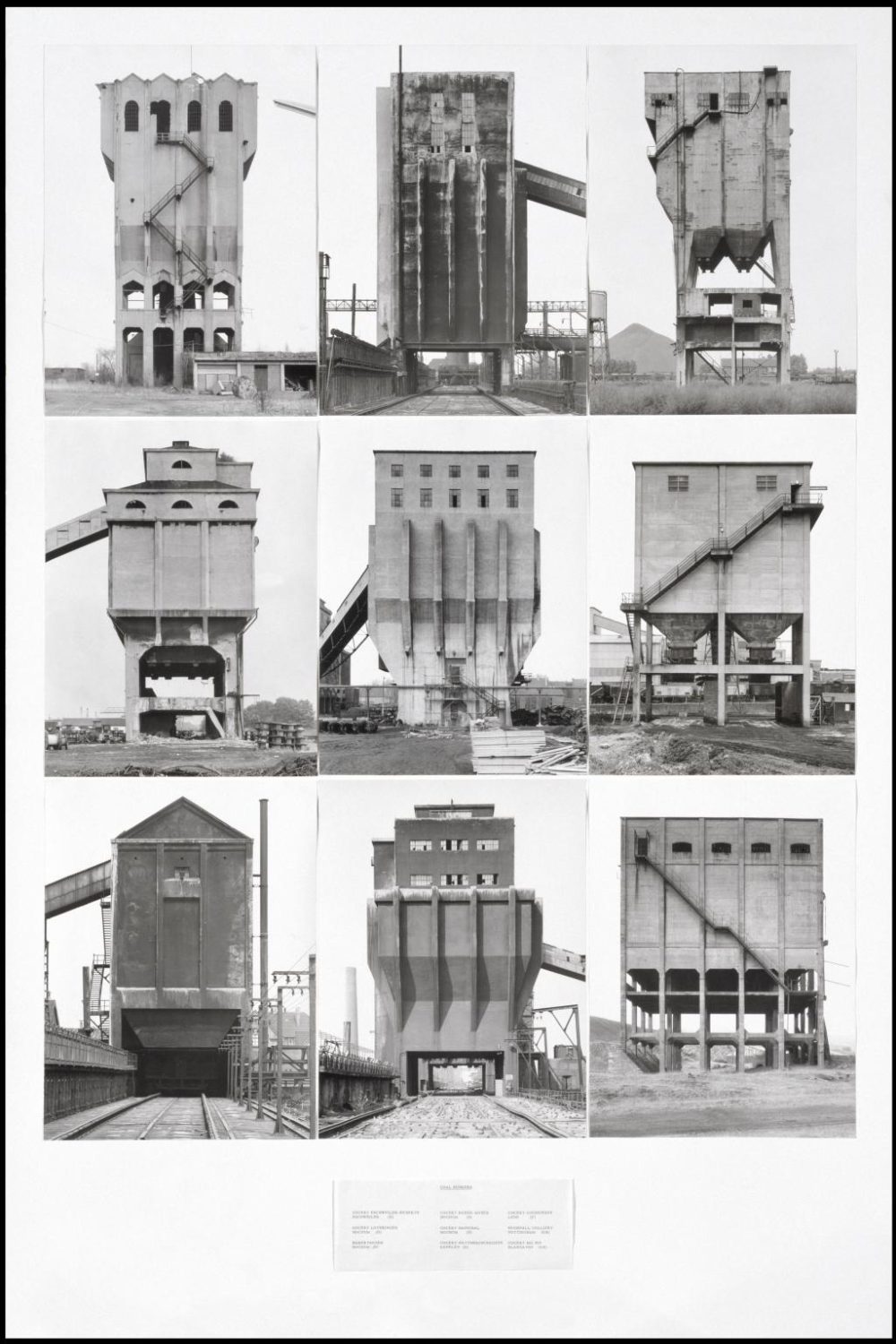
Common to Baltz’s and Bechers’s images is the deadpan aesthetic and the technical rigour. There are no manipulations as one might see in popularist landscape images today, which are more akin to those from a painterly tradition. When asked of this approach to capturing the impacted land, Baltz states “I had a sense of outrage about it … the best way to deal with what I was seeing, I thought, was to try and show as closely as possible what it looked like” (Heiferman, 2010).
Others in the exhibition take a different approach. Stephen Shore was a contributor who also captured scenes from the suburbs and domestic landscapes. His collection Uncommon Places brings together many of these images, Fig. 8 is an example.
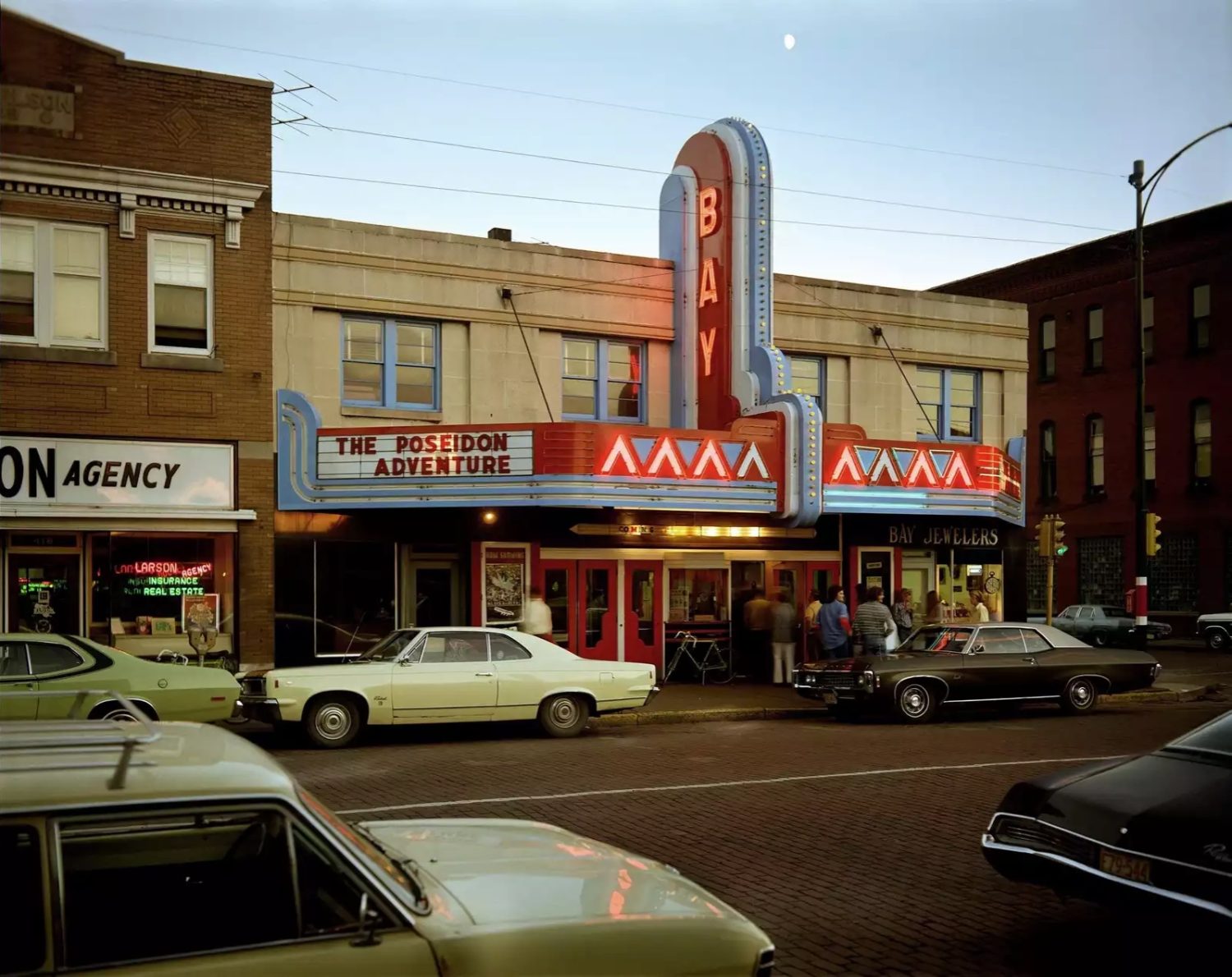
Visually, the image grabs the attention of the viewer more than Baltz’s. Clearly the image is in colour however so are some of Baltz’s images and they are no more attention grabbing than the monochrome ones, see Fig. 9 as an example.
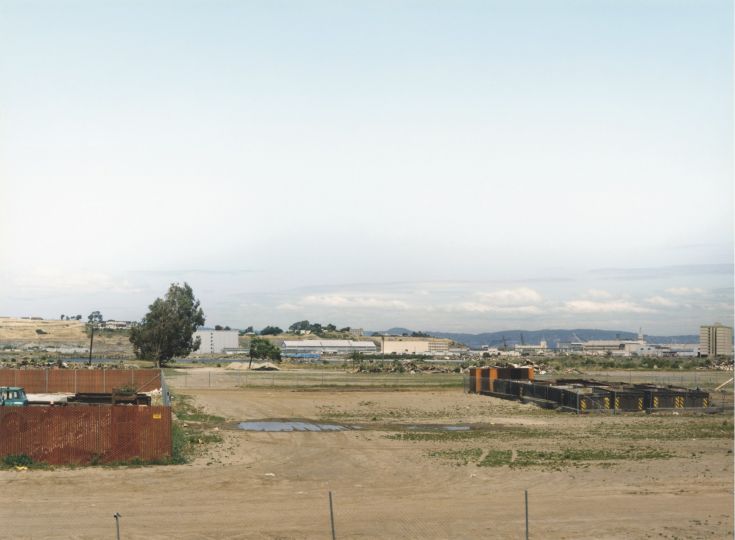
Aside from the colour, although Shore’s are richer or more saturated than Baltz’s, the image contains people, cars, and the cinema shows details of what film was showing, it is all of these and other details that make the image more arresting to casual viewing. It is almost beautiful to look at and so does this mean that the image does not conform to the other collections in New Topographics?
The same technical rigor is present in Shore’s images but this image in particular does seem to eschew the “unflinching, non-romantic view of the ubiquitously marked American landscape, a human landscape that was so unobserved as to be taken for granted” (Artspace, 2016). Fig. 10 is an example of an image from Shore that was part of the exhibition and it can be seen that this is much more similar to those of Baltz, there are no people, the framing is wider and the viewer is left to look at the impact of man on the land.
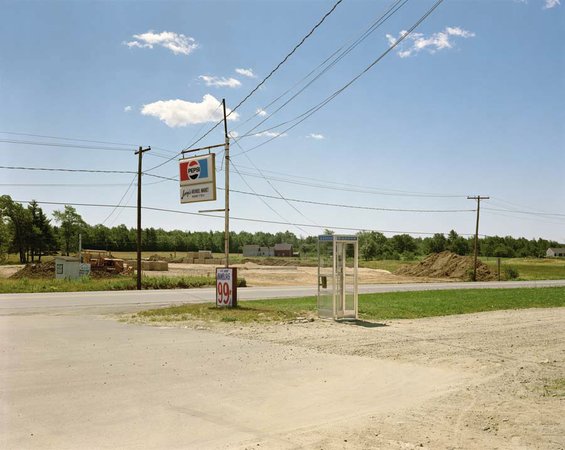
The two different images from Shore show that he adapted the way he captured his scenes according to the intent of what he was trying to show. Although Baltz also changed his approach, for example the close framing of Tract House compared to the looser framing of Candlestick Point, he is more consistent in steadfastly wanting to show an impassive, accurate view of the land. This could be down to his intent in capturing the images and this is discussed next.
Baltz’s Intent and the beauty of his images
Adams states “Making photographs has to be … a personal matter; when it is not, the results are not persuasive” (Adams, 1996:15). If Adams is correct, then this makes Baltz’s unflinching expose of Candlestick Point a personal matter for him as they are certainly persuasive. When talking about the “juggernaut of real estate development”, Baltz does comment “I had a sense of outrage about it” (Heiferman, 2010). This could explain why Baltz’s photographs are all consistent with each other, they are a series of images, by his own words framed widely to show the expanse, that illustrate in technical perfection the destruction of the landscape; the consistency of the images are a mirror onto the consistency of his outrage.
Adams also states that “the job of the photographer, in my view, is not to catalogue indisputable fact but to try to be coherent about intuition and hope” (Adams, 1996:24). Adams himself acknowledges that this is just his point of view, and not provable, but this is a different view to that of Baltz who sought to do exactly the opposite, to capture with high accuracy what was there in front of him.
And yet, whether he intended to be dispassionate or not, Baltz also states “Neutrality is a loaded word, its something you don’t ever totally achieve” (Heiferman, 2010). And so, despite Baltz’s attempt to simply show the landscape, his consistency of intent, driven by his outrage at the destruction, does tell a narrative and it is a personal one.
Thinking of beauty, Adams describes how he conceives beauty as the way in which art represents form, seeing it as a synonym for the structure of underlying life. In that regard, one could consider Baltz’s work as a success, it shows in detail the structure of the land as it now is and allows the viewer to assimilate what has been done to that land. But does it do this though simply recording what is there or representing what was there?
Wells describes representation as something which “celebrates that which is outstanding, striking or intense by singling it out, bringing it into focus.” (Wells, 2011:47). This is where Baltz succeeds, his images, despite their wide expanses, seem to intensify, or focus in on, the work done on the land, the impact of man onto what would otherwise be a natural landscape. If is almost as if these images are of a Late Photography genre leaving the viewer to imagine what has gone before by showing what is there now, and as a result, intensifying the focus on what has gone before even though that is not actually in the images themselves.
Conclusion
Baltz’s series Candlestick Point captures the destruction carried out by man of a natural landscape. The images show what is now there, leaving the viewer to deduce what has been done to the land, and what it looked like before. There is a consistency in the images that matches the consistency of Baltz’s outrage at this destruction. The images are the expression of Baltz’s emotion whilst at the same time being simply a record of what is there, captured with high accuracy Put another way, the collection purports to be simply a technical record of the land and its destruction and yet, this lack of manipulation and the dispassionate presentation curiously tells a story in its own right, one that is congruent with the emotion that triggered the collection at the outset.
The style of the images eschew aesthetics in favour of technical accuracy. They are framed loosely to capture the wide expanses and contain no people which intensifies the viewer’s experience of studying the landscape, undistracted by other subjects. A smaller number of the images in the collection are framed more closely and contain highlighted objects that are carefully positioned to manipulate their juxtaposition with other elements in the frame, either to contrast them or to obscure them to make a point.
Baltz’s style is distinct from others in the New Topographics collection and it is consistent across many of his other works, unlike Shore who adapted his style depending on the intent of the specific images. This consistency serves to intensify the dispassionate nature of the images which in itself intensifies the message of destruction.
The images are presented in book form which Baltz states is a deliberate choice to force the viewer to see the images in the order that he intends. Pages are not numbered and images are not individually titled which gives the images a sense of anonymity, further enhancing the dispassionate feel of the collection. The rhythm of the book is broken up by the inclusion of blank pages and fold out pages that force the viewer to pause, it is these images which gain greater scrutiny.
Word Count excluding quotations = 1987
Total Word Count = 2275
Bibliography
Art Limited. 2017. Lewis Baltz, Exposition, Photography, Fundacion MAPFRE, Madrid, Spain. [online] Available at: <https://www.artlimited.net/agenda/lewis-baltz-exposition-fundacion-mapfre-madrid-photography/en/7583033> [Accessed 1 March 2017].
‘HaganO, S., 2010. New Topographics: photographs that find beauty in the banal. [online] the Guardian. Available at: <https://www.theguardian.com/artanddesign/2010/feb/08/new-topographics-photographs-american-landscapes> [Accessed 17 January 2022].
Heiferman, M., 2010. Lewis Baltz in Conversation with Marvin Heiferman. Art In America, January 2010, p.100.
Steidl Verlag. n.d. Candlestick Point – Lewis Baltz. [online] Available at: <https://steidl.de/Books/Candlestick-Point-0913274354.html> [Accessed 17 January 2022].
Alexander, J., 2015. Perspectives on Place. 1st ed. Fairchild Books, p.122.
Artspace. 2016. Who Killed Romanticism in Photography? Stephen Shore and the Rise of the New Topographics. [online] Available at: <https://www.artspace.com/magazine/art_101/book_report/phaidon-art-in-time-new-topographics-54444> [Accessed 6 February 2022].
Adams, R., 1996. Beauty in photography. 2nd ed. New York, NY: Aperture.
Wells, Liz. 2011. Land Matters: Landscape Photography, Culture and Identity (International Library of Cultural Studies) (p. 47). I.B.Tauris. Kindle Edition.
Images
Figure 1. Baltz, L., 1989. monochrome image from Candlestick Point [image] Available from Steidl Verlag. n.d. Candlestick Point – Lewis Baltz. [online] Available at: <https://steidl.de/Books/Candlestick-Point-0913274354.html> [Accessed 17 January 2022].
Figure 2. Baltz, L., 1989. colour image from Candlestick Point [image] Available from Steidl Verlag. n.d. Candlestick Point – Lewis Baltz. [online] Available at: <https://steidl.de/Books/Candlestick-Point-0913274354.html> [Accessed 17 January 2022].
Figure 3. Lewis, B., 1971. Tract House #22. [image] Available at: <https://www.sfmoma.org/artwork/80.466/> [Accessed 17 January 2022].
Figure 4. Baltz, L., 1989. trifold from Candlestick Point [image] Available from Steidl Verlag. n.d. Candlestick Point – Lewis Baltz. [online] Available at: <https://steidl.de/Books/Candlestick-Point-0913274354.html> [Accessed 17 January 2022].
Figure 5. Baltz, L., 1989. image from Candlestick Point [image] Available from Steidl Verlag. n.d. Candlestick Point – Lewis Baltz. [online] Available at: <https://steidl.de/Books/Candlestick-Point-0913274354.html> [Accessed 17 January 2022].
Figure 6. Clanet, C., 2010. Nino Manfiotto, workman at La Girotte dam from 1942 to 1949. [image] Available at: <https://www.urbanautica.com/post/3876835797/celine-clanet> [Accessed 6 February 2022].
Figure 7. Becher, B. and Becher, H., 1965. Coal Bunkers. [image] Available at: <https://www.tate.org.uk/art/artworks/bernd-becher-and-hilla-becher-coal-bunkers-t01923> [Accessed 6 February 2022].
Figure 8. Shore, S., 1973. Second Street, Ashland, Wisconsin, July 9, 1973,. [image] Available at: <https://www.artsy.net/artwork/stephen-shore-second-street-ashland-wisconsin-july-9-1973> [Accessed 6 February 2022].
Figure 9. Baltz, L., 1989. image from Candlestick Point. [image] Available at: <https://loeildelaphotographie.com/en/lewis-baltz-candlestick-point/> [Accessed 6 February 2022].
Figure 10. Shore, S., 1974. U.S. 1, Arundel Maine, July 17, 1974. [image] Available at: <https://www.artspace.com/magazine/art_101/book_report/phaidon-art-in-time-new-topographics-54444> [Accessed 6 February 2022].