Technical and Visual Skills
From a technical perspective, the most challenging aspect of this assignment was the very high dynamic range that the winter light creates between sky and land, this is exacerbated by the reflection of the sky in the canal which essentially rules out the use of a graduated filter. Building on Exercise 1.8, I chose to use manual exposure and shoot to capture the maximum dynamic range in a single shot and then correct the different elements of the image post-capture. The contact sheets show that this technique meant that nearly all shots were captured quite significantly underexposed looking at the image as a whole but my final images show that the technique has worked for the corrected images – none of them are HDR merged images. I did find that the approach makes the editing process more lengthy as work is required on any given image before it can be appraised for selection or not.
Moving back into the genre of landscape I took care with usage of tripod, remote release, high aperture numbers and hyperfocal focussing, I think all my shots are sharp through the depth of the scenes. The low(ish) resolution images on my blog do not stand up to high levels of zooming in but the original hi-resolution images are sharp at all zoom settings.
Quality of Outcome
Overall, I am pleased with the outcome of the assignment. I think it delivers on my intent which was to show the canal and its surroundings in the context of being a small corridor that is excluded from the Cotswolds AONB. I think as presented on the blog page, the images create a cohesive set whilst each image is sufficiently different to avoid tedium.
The set of images were taken over three different outings. The first I took the majority of the total image set shown in the contact sheets, the second I went back to recapture specific images that I was not happy with but wanted to include in the edit. When I processed them, the weather conditions were too different to the first shoot and so I had to discard them as they would otherwise have created a non-cohesive set. The third set was taken when the weather was similar to the first shoot and so I was able to go back and capture the specific scenes that I wanted to include. Revisiting is something I have not typically done for an assignment, I might previously have tried to fix an issue invisibly in software and inevitably ended with something of lower quality. I am pleased that I did not do that here and chose to revisit. The act of revisiting and suffering from a change of weather is new to me and something to bear in mind for future work given that for landscape photography, this is likely to happen again.
Conceptualisation of thought. my intent was to show a corridor of non-AONB that runs right through the middle of the Cotswold’s AONB and to question its exclusion. I think my images do show a beautiful corridor along with the surroundings which actually are in the AONB. On a map, the delineation is clear, in every image the boundary is actually within the shot but there is obviously no barrier to see and in most cases, not really an ‘edge’ that is visible and perhaps acting as a proxy boundary. I think the images are a success in demonstrating the arbitrary, and false, nature of the boundary.
Demonstration of Creativity
For these images I wanted to make the point that the corridor that is the canal is a beautiful area despite it being explicitly excluded from the Cotswolds AONB. I wanted to create images that conform to the notional conventions of landscape imagery, such as those shown in all of the paintings I found for exercise 1.3, in other words a pictorial approach. But at the same time, I wanted the images to include the elements of industry that cause the area to be excluded. My idea is the two aspects are combined into one scene rather than focussing on one or the other.
Composition wise, I think this is a success. Viewed as thumbnails, the classic pictorial composition of a river (in this case the canal) running through the centre of the scene, and with landscape on either side is visible in all the images, and they combine to create a cohesive set. Detail wise, each contains something different and the compositions are actually all different in subtle ways too.
These choices are deliberate and are contra to the approach of capturing images to show industrial landscape as beautiful in and of itself such as the images produced by Burtynsky (Edward Burtynsky: The Industrial Sublime | Art Museum | University of Wyoming, 2012).
Building on this intent of showing beauty, I did venture down a route of trying to capture images that were a little more atmospheric, for example see contact sheets – image A1-54, but I decided that this would be venturing down a route of ‘Artistic Photography’ as described by Zayas (De Zayas, 1913). When I questioned in my mind why I would go that route, I decided that it could be construed as needing to add something to the image in order to make it more aesthetically appealing. Whilst that might have been an acceptable choice generally or outside the context of this assignment, I realised that it would be somewhat contra to the idea of the assignment which is to show the area’s natural beauty, it does not need a helping hand and so I excluded those images from the set.
I also considered capturing more abstract, or tightly cropped, images. An example could the many images I captured of the circular drain, a feature quite rare and of interest in its own right, for example image A1-38. Again, I decided against this approach because it is at odds with the assignment which is to show the area, its beauty, and its mix of industry and natural beauty.
Emotionally I still find myself wanting to include images such as the aesthetic ones and the abstract ones, but I have retained the discipline to stick to my interpretation of the assignment and the intent I set out with. I am pleased that I have developed the conscious thought to make these decisions. I think if I had done this assignment two years ago, I would have opted for an eclectic mix and not really understood why the set did not deliver on my intent.
In a further development from the past, I also think that I would previously tried to capture the scenes EXCLUDING the industry in an attempt to show that the area was beautiful anyway. For example Figure 7 from my submission I might have cropped differently as shown below. It may be more classically ‘beautiful’ but it would not deliver on the intent of my assignment. Again, this is a development I am pleased with – the confidence to show things just as they are rather than try and redefine something and in the process lose the whole point of the image.

Assignment Cropping 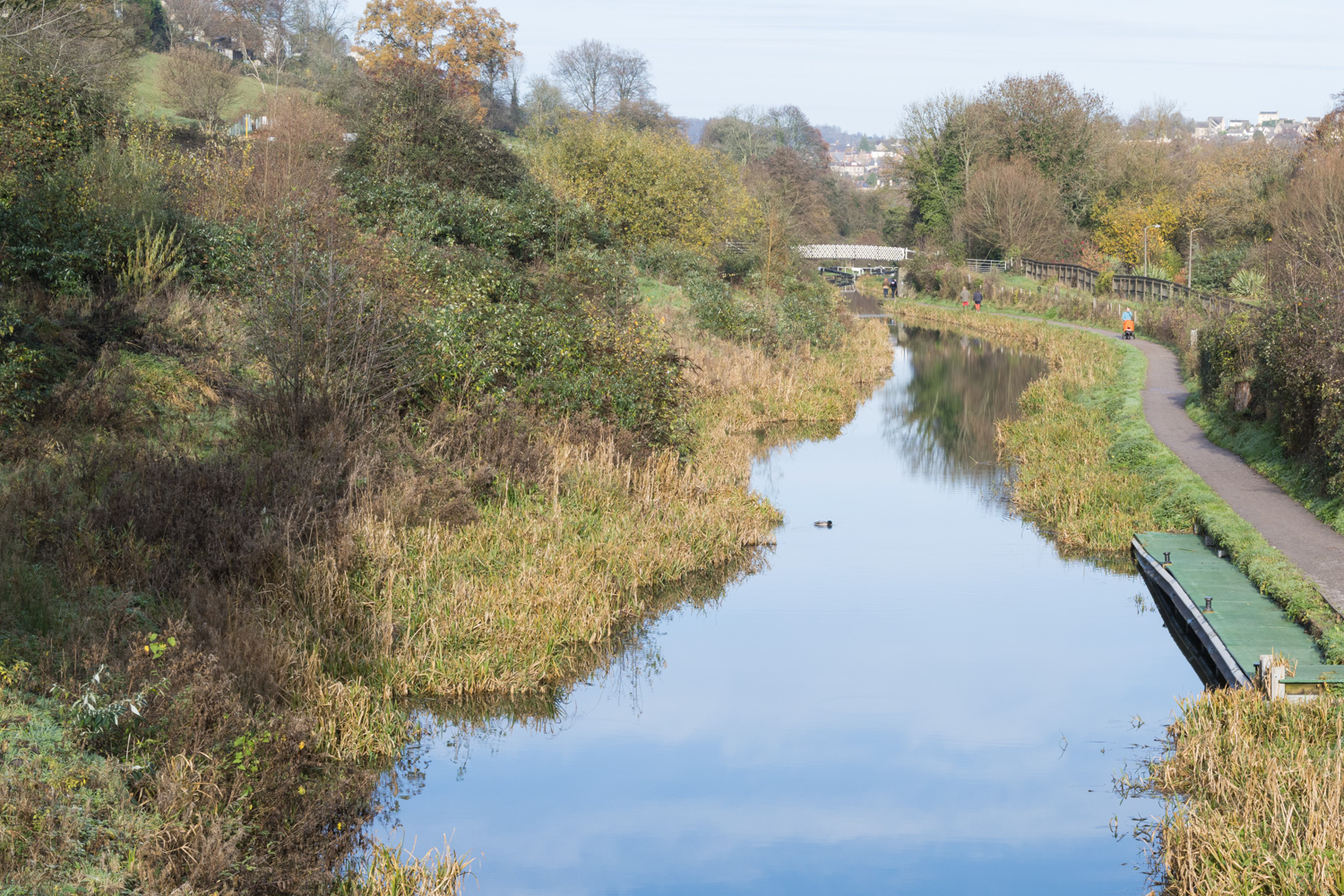
Cropping excluding industry
On naming of the images, as all of the images are of the canal I felt that calling them all Thames and Severn Canal Image 1 etc. was too monotonous. I considered naming the image according to the village closest to each scene but I did not feel that this was specific enough. Ultimately I decided to use a technique that I have seen used by David Wyatt (Wyatt, 2019) in his Sandford Hill images where he uses a map reference. In my case, I have chosen to use Lat / Long reference points which locates the view seen in the image rather than the spot that the image was taken from. Given the starting point for this body of work was a map and the precise boundaries of the AONB, the naming convention linking back to maps felt appropriate.
Context
On research, much of my research is mentioned in my reflection above. Additional thinking for this assignment:
The different ways that a landscape can be captured. Specifically I considered the different techniques used by Partyka (Partyka, n.d.) in his collection ‘Black Fen’ within which he uses classic conventional framing but also includes much more abstract images. His set gave me the inspiration to try the different styles I have previously discussed but also the confidence to stick with the conventional framing.
Other photographers canal images. Most show images along canals, but just the canal, or they show the ruins of canals past. I did not feel that this research helped my thinking all that much.
Finally I looked at industrial imagery that attempts so show it in a light of beauty, for example the photography of Burtnynsky (Edward Burtynsky: The Industrial Sublime | Art Museum | University of Wyoming, 2012), but as already stated, I felt that this photopgraphy was focussed on the industrial components themselves. This did however give me clarity in my own mind that my purpose was to show the entire scene – industrial elements and natural elements juxtaposed together in a single scene and so this research I found helpful even though I did not then follow its approach.
Bibliogrpahy
Uwyo.edu. 2012. Edward Burtynsky: The Industrial Sublime | Art Museum | University Of Wyoming. [online] Available at: <http://www.uwyo.edu/artmuseum/exhibitions/archives/2012/edward-burtynsky/> [Accessed 6 December 2020].
De Zayas, M., 1913. Photography And Photography And Artistic-Photography. [article] Available at: <https://www.camramirez.com/pdf/DI_Week6_PhotoAndArt.pdf> [Accessed 30 October 2020].
Partyka, J., 2011. Black Fen. [online] PlacesJournal.org. Available at: <https://placesjournal.org/article/black-fen> [Accessed 18 October 2020]
Wyatt, D., 2019. David Wyatt – Sandford Hill. [online] Davewyatt.co.uk. Available at: <https://davewyatt.co.uk/sandford-hill> [Accessed 30 October 2020].