Part 1 – My Road
Photograph a road near you in any style you choose.
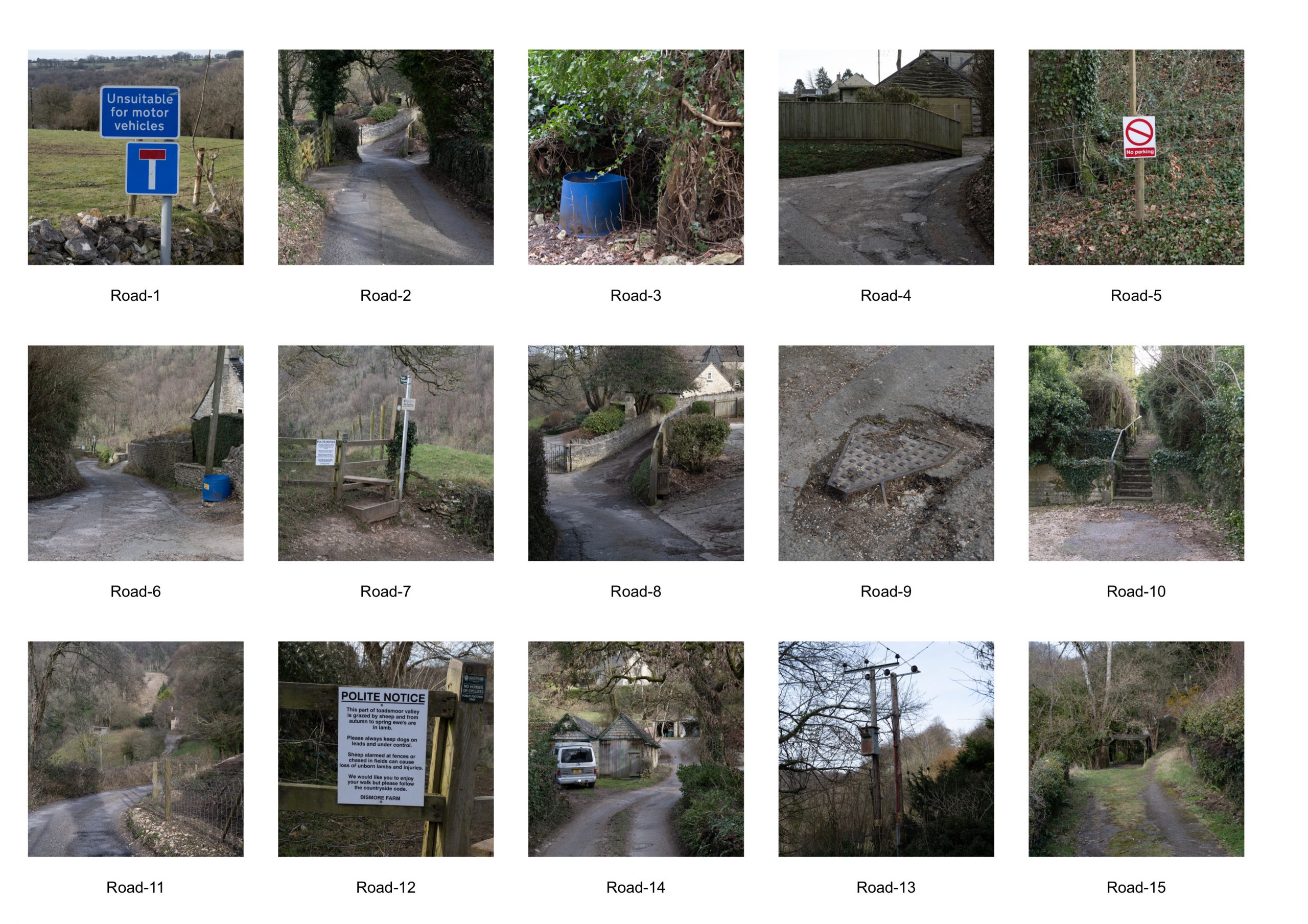
I found this exercise interesting, as the contact sheet shows, I took a variety of shots but roughly half were shot looking along the road itself and half picking out points of interest along the road. On the contact sheet I have alternated which I hope conveys some sense of travelling along the road and looking at details along the way. The road in question is the road that leads to my house and as the first image shows, it is classed as unsuitable for motor vehicles which is not fantastic for COVID deliveries. In fact, the road is perfectly suitable and we who live along it drive it most days.
What I found interesting in the exercise wise that I noticed a lot of things along the road that I have not noticed in the three years that I have lived here. I also found the shots of the road interesting in the way that it curves in and out of shot, again this is not something I have really noticed before.
I chose to shoot in square format because I did this exercise after researching Robert Adams and his series Summer Nights Walking which was also shot in square format. For the detailed shots, I wanted the focus to be on the details, not the wider shot, just as Adams does. I found this worked well for the detail but was slightly limiting for the shots that would have been wider but I stuck with square for the entire series for consistency. Overall I like the use of the square framing in the series.
I think Road-1 sets the scene well and in terms of understanding the nature of the road itself, Road 6, 8, 11 and 14 portray it will. The details in between in other images such as Road 3, 5 or 9 give a greater sense of the ‘feel’ of the road I think.
Part 2 – Watch a film that includes a road trip and review how the road features as part of the film
I watched the film The Road Perdition, a film in which “A mob enforcer’s son witnesses a murder, forcing him and his father to take to the road, and his father down a path of redemption and revenge.” (Road to Perdition (2002) – IMDb, n.d.)
In the film, the father and son follow a path of escalating challenge as they attempt to seek revenge on the Mafia for the murder of the father’s wife and other child. The sense of a journey pervades throughout the film from the opening scene which shows the boy riding home on his bicycle. At this stage, all is well and the boy riding his bike, and playing snowballs in the snow evokes a sense of innocence. A precedent is set even at this stage though, whilst the boy riding the bike is part of the story, it is not the story itself, all that happens when the boy rides his bike is that he moves from one scene to the next.
Next we learn that the father is in fact a hit man for the mafia and then whilst on a job, the son, who is unaware of this, stows away in the trunk of the father’s car whilst on a job to try and find out what he does for a living. We don’t know it yet but this is the introduction of a car being the main instrument of a journey throughout the rest of the film. Unfortunately, the son sees a shooting and then a second hitman, who is the boss’s son, sees the boy and this is what triggers the shooting of the father’s wife and other child and what triggers the trail of perdition.
We see the father and his surviving son leaving their house in the car. As they leave, we see the child’s bike from the opening scene abandoned in the snow. The original, innocent, journey is over and new journey begins in the car.
For the rest of the film a pattern follows. The car is used to transport the father and son from scene to scene. It is occasionally part of an actual scene, for example it is used as a getaway car during a bank robbery, but more usually the scenes of new story are in between the car journeys. Given that their situation worsens in each main story point, we are left feeling a sense of foreboding every time the pair go on their next step of the journey in the car.
Directed by Sam Mendes, what we see in this film is a very clear sense of journey, but it is not the physical one made in the car. The car journeys are used to mark stages in the story, they emphasise that the next step to Perdition is about to happen. The story could easily have been made in one place, the story does not depend on the journey itself, however the usage of the car journeys in between each stage of the story serves to emphasise the stages and just how far their plight descends during the journey. In that sense, the car journey is a metaphor for the journey of the pair to perdition.
This approach reminds me somewhat of Soth’s Sleeping by the Mississippi (Soth, 2004)
in the sense that his images are made traveling along the Mississippi area but they never show the river itself. It is not exactly the same, for Soth, there is no sense of the river linking the images to portray a continuous story, it is simply that the river guided Soth’s travels. What is common though is that the material that matters is outside the context of the journey (or river) itself. In both examples the road and the river simply guide the narrative.
Bibliography
IMDb. n.d. Road to Perdition (2002) – IMDb. [online] Available at: <https://www.imdb.com/title/tt0257044/?ref_=nv_sr_srsg_0> [Accessed 9 February 2021].
Soth, A., 2004. Alec Soth | Sleeping by the Mississippi. [online] Alecsoth.com. Available at: <https://alecsoth.com/photography/projects/sleeping-by-the-mississippi> [Accessed 29 January 2021].